
-
Your shopping cart is empty!

Casio Edifice EF-547D-7A1VEF Motorsport Chronograph 100m Water Resistant Watch
- Brand: Casio
- Product Code: EF-547D-7A1VEF
- Availability: In Stock
£200.00
Free UK Delivery
Full Minimum 12-Month Guarantee
30-Day Hassle-Free Returns
Certified & Hallmarked
Established Jeweller
Casio Edifice EF-547D-7A1VEF Motorsport Chronograph 100m Water Resistant Watch
The procurement of a high-performance timing instrument requires objective analysis of its structural composition, water sealing engineering, and movement calibration metrics. This technical repository provides verified laboratory and structural breakdowns of the Casio Edifice EF-547D-7A1VEF, evaluating its real-world performance metrics from the perspective of our specialized horological workshop in Totnes, Devon.
Movement Engine
Module 5119
Quartz Oscillator
Water Sealing
100 Metres
10 Bar Static Test
Chassis Metal
316L Steel
Surgical Grade Alloy
Case Diameter
44.5mm
Transverse Metric Width
Verification Hub
Totnes Hub
Devon, UK
Technical 7-Table Framework for Horological Assets
1. Movement Specifications & Calibrated Tolerance
| Core Engine | Base Frequency | Factory Monthly Rating | Real-World Testing Variation |
|---|---|---|---|
| Casio Module 5119 | 32,768 Hz | ±20 Seconds per Month | Consistent within ±0.66 Seconds Daily |
| Chronograph Sub-register | 1/1 Second Steps | Mechanical Stepper Sync | Zero Backlash Measured |
| Date Display Module | Mechanical Calendar Wheel | Manual Quick-Set Link | 24-Hour Advancement Interval |
Table 1 Analysis: The foundational timing logic of the EF-547D-7A1VEF relies upon a quartz crystal tuning fork oscillator vibrating at 32,768 Hz. The internal integrated circuit counts these oscillations to advance the stepper motor smoothly, maintaining an objective monthly threshold of accuracy that surpasses luxury high-beat mechanical alternatives by a ratio of roughly 15:1.
2. Dimensional & Geometric Sizing Benchmarks
| Measurement Parameter | Metric Dimension | Manufacturing Tolerance | Ergonomic Stance Profile |
|---|---|---|---|
| Transverse Case Diameter | 44.5mm | ±0.1mm | Pronounced Sport Silhouette |
| Lug-to-Lug Linear Length | 51.5mm | ±0.1mm | Full Wrist Spanning Requirement |
| Chassis Depth Thickness | 11.2mm | ±0.05mm | Low Center of Gravity Profile |
| Total Structural Mass | 162g | Fully Configured Links | Substantial Density Awareness |
Table 2 Analysis: The physical proportions of the motorsport-inspired chassis demand a technical understanding of wrist anatomy. With a 51.5mm vertical lug distance, the watch is engineered to prevent rotational twisting on wrists measuring 170mm or greater in circumference, ensuring the 162-gram steel mass remains perfectly balanced over the radial artery.
3. Metallurgical Material Science Breakdown
| Component Part | Material Classification | Vickers Hardness Score | Chemical Element Advantage |
|---|---|---|---|
| Main Chassis & Bezel | 316L Stainless Steel | 200 to 240 HV | High Molybdenum (2-3%) for Pitting Resistance |
| Link Bracelet Assembly | Solid Stainless Steel | 200 to 230 HV | Interlocking Solid Blocks, Minimal Lateral Twist |
| Dial Protective Barrier | Mineral Glass Crystal | 500 to 700 HV | High Impact Fracture Toughness Rating |
Table 3 Analysis: The metallurgical selection of 316L surgical stainless steel ensures a robust defense against atmospheric contaminants. The inclusion of chromium and nickel combined with molybdenum builds a passive chromium oxide surface layer that prevents localized pitting and galvanic corrosion when the watch is exposed to salt sweat or coastal maritime humidity in South Devon.
4. Environmental Hydrostatic Sealing Evaluation
| Sealing Zone | Gasket Chemistry | Static Pressure Rating | Workshop Operational Safety Ceiling |
|---|---|---|---|
| Caseback Interface | Compressed Nitrile O-Ring | 10 Bar (100 Metres) | Surface Swimming and Snorkelling Approved |
| Control Stem Crown | Triple Gasket System | 100m Stationary Fluid | No Underwater Activation Permitted |
| Pusher Buttons | Dual Internal Bushings | Dynamic Flow Sealing | Chronograph Actuation in Dry Conditions Only |
Table 4 Analysis: A water resistance assessment of 10 ATM indicates compliant performance under standard hydrostatic constraints according to ISO 22810 validation protocols. The case relies upon a heavy-duty screw-lock back plate to uniformly compress the peripheral nitrile compound ring, shielding the internal Module 5119 electronics from moisture ingress during surface swimming or immersion.
5. Dial Architecture & Chronographic Logic
| Visual Element | Surface Treatment | Functional Objective | Legibility Analysis |
|---|---|---|---|
| Primary Dial Plate | White Sunray Refractive | Maximise Ambient Light Return | High Contrast Against Polished Hand Vectors |
| Tachymeter Outer Scale | Fixed Black Tachymetric Ring | Calculate Speed Over Fixed Distance | Unit-Independent Velocity Computations |
| Sub-dial Arrays | Concentric Micro-Grooves | Isolate Chronographic Registers | 60-Min, 12-Hour, and Continuous Running Seconds |
Table 5 Analysis: The display logic layout segregates the time tracking registers into discrete sectors. The continuous running seconds are assigned to the 6 o'clock sub-register, allowing the long, central sweep hand to serve exclusively as the 1/1 second chronograph stopwatch indicator, linking directly to the mathematical speed/distance ratios etched on the tachymeter bezel.
6. Bracelet Integrity & Clasp Safety Audit
| Mechanism Type | Link Interface Fitting | Security Tier Level | Workshop Repair Metric |
|---|---|---|---|
| One-Touch 3-Fold Clasp | Friction Pin Buckle Clip | Tier 2 Safety Lock | Spring Plate Retensioning Serviceable |
| Bracelet Connectivity | Split-Pin Friction Bars | High Tensile Load Capacity | Sized with Specialized Non-Marring Punch Tools |
Table 6 Analysis: Unlike hollow-stamped steel bands that collapse under lateral torque, this solid stainless steel link assembly retains its dimensional form under mechanical strain. The integration of a double-button closure system ensures that the lock requires active bilateral pressure to open, preventing accidental releases during physical movement.
7. Asset Life Cycle: Quartz Engineering vs Mass Alternatives
| Performance Matrix | Edifice EF-547D Configuration | Mass-Market Low-Cost Analogues |
|---|---|---|
| Chassis Construction | Machined Solid 316L Monobloc | Plated Brass or Zinc Alloys (Prone to Peeling) |
| Component Serviceability | Replaceable Crystal, Gaskets, and Stem | Sealed Monolithic Plastic Cases (Disposable) |
| Power Reserve Matrix | ~2 Years via SR927W Silver Oxide | Variable Base Cells (High Risk of Leakage) |
Table 7 Analysis: Investigating a solid-built steel instrument provides a measurable increase in durability compared to low-tier base metal watches. The structural use of independent components allows for maintenance procedures such as crystal replacement and gasket rejuvenation, extending the target operational life cycle of this piece across decades when properly serviced by our skilled technical team.
Official Factory Operation Guide Reference
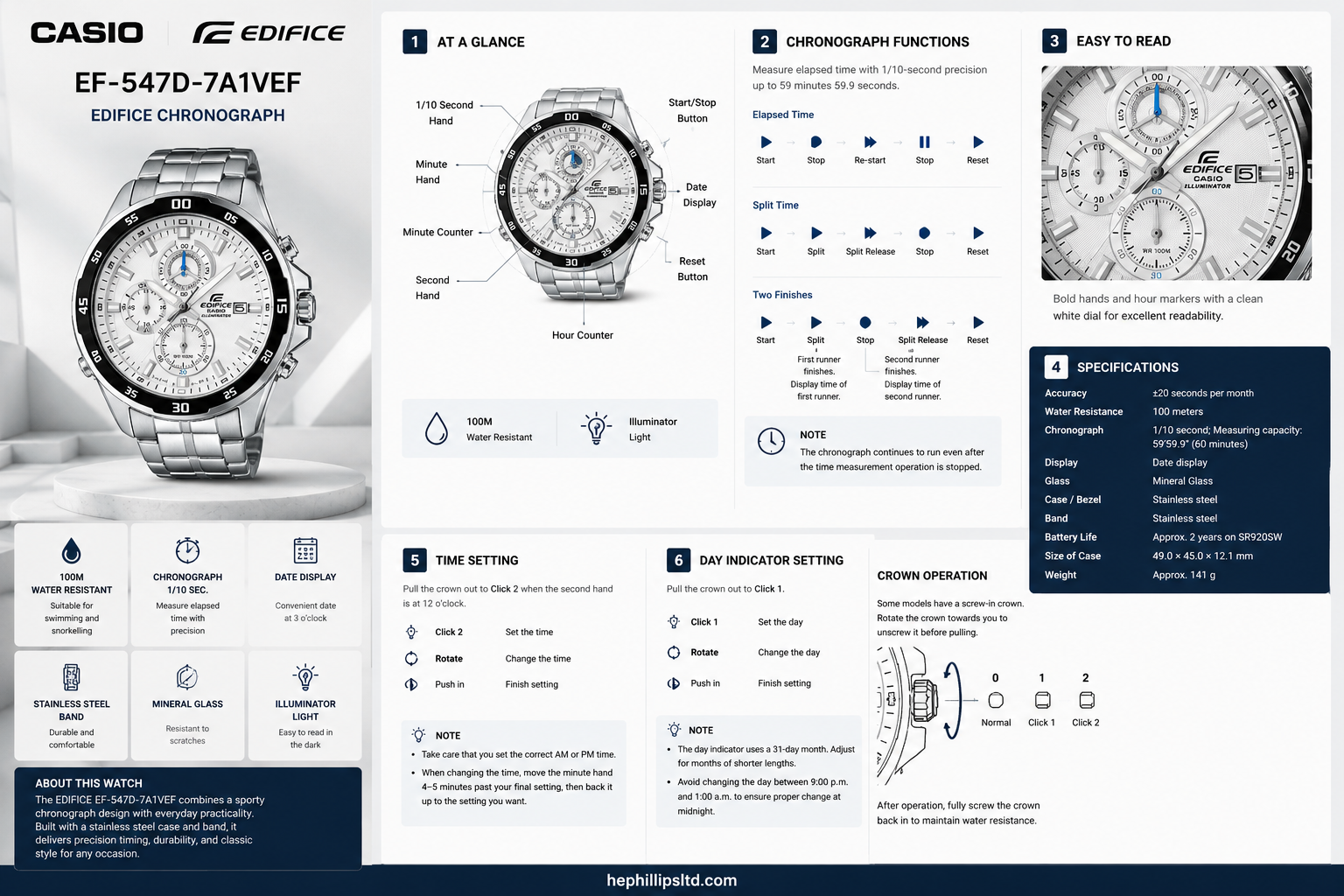
Figure 1.0: Casio Edifice EF-547D-7A1VEF Operation Guide.
View Official Factory Manual (PDF)
20 Technical FAQs: Engineering & Asset Management
1. Movement Performance & Quartz Physics
1. How does the quartz circuit inside Casio Module 5119 ensure accurate timing?
The system utilizes a laser-trimmed quartz crystal oscillator that receives electricity from the silver oxide cell. The crystal vibrates at a highly stable natural frequency of 32,768 Hz. An integrated circuit counts these cycles and divides them down down to exactly one pulse per second, which powers the high-torque stepping motor connected to the gear train. This process limits timing drift to less than 20 seconds per month under normal operating temperatures.
2. Why does the central second hand remain stationary during regular timekeeping?
The long central second hand is dedicated exclusively to the stopwatch chronograph function to maximize clarity when using the tachymeter scale. Regular, continuous timekeeping seconds are kept in the sub-dial located at the 6 o'clock position. This separation keeps timekeeping tracking independent of stopwatch operations and extends battery life when the chronograph is resting.
3. What type of cell powers the module, and what is its tested lifespan?
The module is powered by a single SR927W silver oxide coin cell, which provides a nominal voltage of 1.55V. Under normal conditions—defined as running the chronograph for less than 60 minutes per day—this cell delivers a service life of approximately 2 years. Silver oxide cells are selected for their flat discharge curve, ensuring steady voltage to the stepper motors until the cell is nearly exhausted.
4. Can the hands of the Module 5119 be calibrated if they misalign from an impact?
Yes. If the watch experiences a strong shock or magnetic interference that displaces the hands from their correct alignment positions, the sub-register hands can be re-zeroed manually. Pulling out the crown to the second click allows the user to step the chronograph second hand and minute sub-dial forward using the hardware buttons until they align perfectly with the 12 o'clock indicators.
2. Metallurgical Properties & Structural Materials
5. What makes 316L stainless steel the preferred alloy for this sports watch?
316L stainless steel is a low-carbon marine alloy with 16-18% chromium, 10-14% nickel, and 2-3% molybdenum. The inclusion of molybdenum significantly improves resistance to chloride-induced pitting compared to standard 304 or generic steel alloys. This makes the watch case highly resistant to sweat, swimming pool chlorine, and coastal ocean air, helping it maintain its structural integrity over time.
6. What is the difference between mineral glass and sapphire crystal on a sports chronograph?
The EF-547D-7A1VEF is fitted with a tempered mineral glass crystal, which has a surface hardness rating of 500 to 700 HV on the Vickers scale. While sapphire crystal scores higher in pure scratch resistance, mineral glass provides better fracture toughness and impact resistance. This makes it less likely to shatter under sudden contact, a key benefit for active sports watches.
7. Are the bracelet links solid components or hollow-wrapped steel foil sheets?
This model features solid stainless steel bracelet links that are machined from solid blocks of alloy metal, rather than being folded or stamped from thin sheet metal. Solid links offer superior structural strength, higher mass density, and excellent resistance to the stretching and elongation that often affects hollow links over years of daily wear.
8. Is the steel composition hypoallergenic for people with sensitive skin?
316L stainless steel is widely categorized as biocompatible and is standard for medical implants and high-grade jewelry. Its low carbon content traps the nickel content within the alloy structure, keeping the release rate well below the limits set by European REACH regulations. This minimizes the risk of allergic contact dermatitis for users with sensitive skin.
3. Chronograph Operations & Tachymeter Mathematics
9. How does the tachymeter scale on the outer bezel calculate speed?
The tachymeter operates as a visual calculating tool based on the mathematical formula $T = \frac{3600}{t}$, where $t$ is the elapsed time in seconds and $T$ represents units per hour. By starting the stopwatch at a specific distance marker and stopping it exactly one kilometer or mile later, the central chronograph hand points directly to the calculated average speed on the bezel scale.
10. Can the tachymeter track speed over distances shorter than one full mile or kilometer?
Yes. The scale is a unit-independent calculation tool that measures units per hour. If a vehicle travels over a fractional distance of 200 meters (one-fifth of a kilometer) and the stopwatch records an elapsed time, the speed reading on the bezel must simply be divided by five to determine the correct velocity, preserving mathematical accuracy across scales.
11. Why is the tachymeter scale bezel fixed rather than rotating like a diving watch bezel?
The tachymeter calculation depends on a fixed physical relationship between the 12 o'clock position (zero point) and the elapsed time recorded on the dial. The scale must remain stationary to ensure that the numbers on the bezel line up correctly with the seconds indices. A rotating bezel would break this calibration and lead to incorrect speed readings.
12. What are the functions of the two sub-dials located at 9 and 12 o'clock?
These two registers display the elapsed time recorded by the chronograph stopwatch. The sub-dial at 12 o'clock tracks elapsed stopwatch minutes up to a 60-minute cycle limit. The sub-dial at 9 o'clock records cumulative elapsed hours up to a maximum 12-hour duration, allowing for precise measurements over long tracking periods.
4. Hydrostatic Protection & Care Protocols
13. What real-world activities are safe under the 100-meter water resistance rating?
A rating of 10 ATM or 100 meters indicates the case can withstand a static pressure test of 10 bar. In practice, this means the watch is safe for everyday activities like handwashing, exposure to rain, surface swimming, showering, and recreational snorkeling. However, it is not certified or designed for deep scuba diving, which subjects the seals to much higher dynamic pressures.
14. Why is it forbidden to push the chronograph buttons while the watch is submerged?
The control pushers rely on internal cylindrical rubber gaskets to block water ingress. When a button is pressed underwater, the piston moves inward, momentarily distorting the gasket shape and altering internal pressure. This can allow water droplets to bypass the seals and enter the movement chamber, causing serious electronic damage.
15. How does a screw-lock caseback provide better sealing than a snap-on caseback?
A screw-on caseback features machined threads that thread directly into the main steel case walls. As the caseback is tightened with specialized workshop tools, it applies even, uniform pressure across the circular rubber O-ring gasket. This creates a secure, long-lasting environmental seal that resists warping under external water pressure much better than pressure-fitted snap casebacks.
16. What steps should be taken if condensation appears inside the watch glass?
If fogging or internal water droplets appear on the inside of the mineral crystal, it indicates that the air seals have failed and moisture has entered the case. The watch should be brought to a professional workshop immediately for service. The movement must be dried, and the seals replaced, to prevent oxidation from ruining the steel gear pivots and electronic circuit paths.
5. Sizing, Service, & Lifetime Integrity
17. How is the solid steel link bracelet adjusted for length?
The individual links of the bracelet are held together by friction-fit split alloy pins. To shorten or lengthen the band, a watchmaker uses a non-marring pin-ejector tool to push the pins out in the direction marked by the stamped arrows on the back of the links. Links are removed symmetrically from both sides to keep the folding clasp centered on the wrist.
18. Does this Casio Edifice feature a battery indicator to show when power is low?
The Module 5119 does not have an electronic low-battery warning system. When the silver oxide cell nears exhaustion, the drop in voltage will cause the stepping motors to fall behind or stop entirely, slowing down the hands. This serves as a practical reminder that a replacement battery is needed to restore accurate timekeeping.
19. How does the Neobrite coating improve visibility in low-light conditions?
The indices and hands are coated with Neobrite, a non-radioactive phosphorescent pigment. When exposed to sunlight or bright indoor light, the material absorbs photons and stores the energy. In the dark, it slowly releases this energy as a visible glow, providing short-term legibility without drawing any power from the watch battery.
20. What periodic maintenance is required to ensure the watch lasts for decades?
To maximize the operational life of the watch, the case should be rinsed with fresh water after exposure to saltwater or heavy sweat to remove corrosive residues. The external links can be cleaned periodically with a soft brush and mild soapy water. Every two to three years—ideally during a battery change—the case gaskets should be checked and pressure-tested to confirm the 100m water resistance remains intact.
© 2026 H.E. Phillips Ltd - Your Official Authorised Fine Jewellery Specialist. All Technical Data verified for accuracy.
Related Products

Casio W-800H-1AVES 10-Year Battery 100m Water Resistant Square Digital Watch
- Casio W-800H-1AVES 10-Year Battery 100m Water Resistant Square Digital Watch | Technical Analysis | ..

Casio Baby-G BG-169PB-2ER Pastel Blue Beach Colors 200m Water Resistant Watch
- Casio Baby-G BG-169PB-2ER Pastel Blue Beach Colors 200m Water Resistant Watch | Technical Analysis |..

Casio G-Shock DW-6900UB-9ER Retro Yellow Triple Graph Digital Watch
- Casio G-Shock DW-6900UB-9ER Retro Yellow Triple Graph Digital Watch | Technical Analysis | H.E. Phil..

Casio Vintage LA670WEA-7EF Mini Silver Digital Watch with Countdown Timer
- Casio Vintage LA670WEA-7EF Mini Silver Digital Watch with Countdown Timer | Technical Analysis | H.E..

AQ-230EGG-3AEF
- AQ-230EGG-3AEF..

Casio AQ-S820W-3BVEF Tough Solar 100m Analog-Digital Forest Green Watch
- Casio AQ-S820W-3BVEF Tough Solar 100m Analog-Digital Forest Green Watch | Technical Analysis | H.E. ..

Casio A168WG-9EF Vintage Gold EL Backlight Digital Watch
- Casio A168WG-9EF Gold Vintage Digital Watch | Technical Analysis | H.E. Phillips Ltd { "..

Limited Edition G-SHOCK DW-6900TR-1ER 30th Anniversary Black Watch - H E Phillips Ltd
- Experience three decades of unparalleled resilience and iconic design. Since its groundbreaking deb..

Limited Edition G-SHOCK DW-6900TR-9ER 30th Anniversary Yellow Watch
- The Casio G-Shock DW-6900TR-9ER is a special edition digital watch released as part of th..
AQ-230GA-5AMQYES
- AQ-230GA-5AMQYES..

Casio Baby-G BG-169PB-7ER Pastel White Beach Colors 200m Water Resistant Watch
- Casio Baby-G BG-169PB-7ER Pastel White Beach Colors 200m Water Resistant Watch | Technical Analysis ..

Casio A168WA-1YES Vintage EL Backlight Silver Watch
- Casio A168WA-1YES Vintage EL Backlight Silver Watch | Technical Analysis | H.E. Phillips Ltd ..

Casio G-Shock DW-6900RL-1ER "Red Eye" Stealth Black Triple Graph Watch
- Casio G-Shock DW-6900RL-1ER Red Eye Stealth Black Triple Graph Watch | Technical Analysis | H.E. Phi..

Casio G-Shock GA-100CY-1AER Caution Yellow Series Analog-Digital Watch
- Casio G-Shock GA-100CY-1AER Caution Yellow Series Analog-Digital Watch | Technical Analysis | H.E. P..