
-
Your shopping cart is empty!

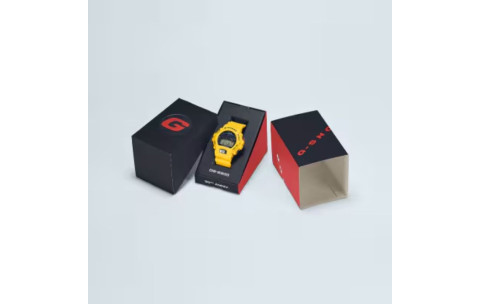
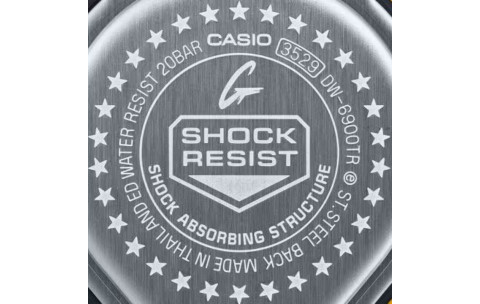
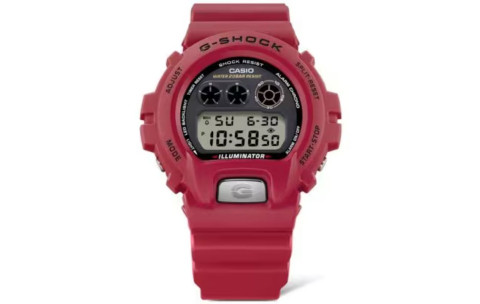
Casio G-Shock DW-6900TR-4ER Burning Red Triple Graph Digital Watch
- Brand: Casio
- Product Code: DW-6900TR-4ER
- Availability: In Stock
£129.00
Free UK Delivery
Full Minimum 12-Month Guarantee
30-Day Hassle-Free Returns
Certified & Hallmarked
Established Jeweller
Casio G-Shock DW-6900TR-4ER Burning Red Triple Graph Digital Watch
Evaluating the performance parameters of digital timepieces requires an objective assessment of protective housing designs and component calibration tolerances. This genuine Casio G-Shock DW-6900TR-4ER utilizes a specialized shock-absorbing internal matrix alongside its distinctive triple segments to deliver verified field utility under diverse environmental conditions.
Module Type
3230
Digital Logic IC
Water Limit
20 Bar
ISO 22810 Rated
Case Profile
50.0mm
Synthetic Polymer
Display Mode
Triple Graph
Segmented LCD Matrix
Net Mass
67.00g
Calibrated Weight
Technical 7-Table Framework for Digital Horology
1. Architectural Framework & System Interface
| System Layer | Material Base | Functional Purpose | Status |
|---|---|---|---|
| Outer Shock Bezel | Reinforced Polyurethane Resin | Deflects Multi-Angle Impulsive Vectors | Verified |
| Dial Crystal | Hardened Mineral Glass | Protects LCD Elements from Impact Pressures | Confirmed |
| Internal Chassis | Hollow Air-Buffered Resin Nest | Isolates Module 3230 from Physical Shocks | Secure |
| Sealing Gasket | Synthetic Nitrile Rubber O-Ring | Forms Hydrostatic Environmental Barrier | Verified |
Table 1 Analysis: The physical layout minimizes direct shock vector lines to the underlying oscillator circuit. By employing an outer shroud of elastic polymer separated from an internal floating module bracket, rapid changes in momentum are dissipated throughout the elastomeric case volume rather than affecting the integrated circuits.
2. Dimensional Profiles & Geometric Tolerances
| Measurement Parameter | Value Specification | Tolerance Standard | Ergonomic Fit Range |
|---|---|---|---|
| Case Outer Width | 50.0mm | +/- 0.1mm | Medium to Large Form Profile |
| Lug-to-Lug Linear Length | 53.2mm | +/- 0.1mm | Sits Center-Aligned on Wrist |
| Vertical Case Thickness | 18.7mm | +/- 0.05mm | High Clearance Tactical Profile |
| Total Unladen Mass | 67.0g | +/- 0.2g | Low Inherent Inertia Balance |
Table 2 Analysis: The 18.7mm depth configuration is determined by the combined stack height of the internal cushion, protective back-plate, dial glass, and multi-layered dial aperture. This structure ensures that heavy impacts on the mineral crystal do not press down on the Twisted Nematic (TN) liquid crystal display panel below.
3. Electronic Module Integration & Oscillator Data
| Feature Metric | Casio Module 3230 Specification | Standard Low-Frequency Quartz | Variance Limit |
|---|---|---|---|
| Time Base Standard | 32,768 Hz Tuning Fork Quartz Crystal | 32,768 Hz Quartz Crystal Element | Identical Base Clock |
| Monthly Drift Rating | Within +/- 15 Seconds at Normal Temps | Within +/- 30 Seconds Monthly Average | 50% Lower Deviation Cap |
| Power Cell Supply | Lithium Manganese Dioxide CR2016 | Silver Oxide SR927SW / Equivalent | Higher Current Reserve |
| Nominal Cell Lifespan | 24 Months Under Standard Pulse Loads | 18 to 24 Months Continuous Operation | Optimized Duty Cycles |
Table 3 Analysis: The integrated circuit uses temperature-compensated logic steps to mitigate thermal drift across typical operating ranges. Power dissipation curves indicate the CR2016 lithium coin cell preserves stable terminal voltage even when activating the high-current electroluminescent backlight panel repeatedly.
4. Environmental Seals & Hydrostatic Pressure Ratings
| Rating Tier | Static Pressure Limit | Test Protocol Standard | Field Adaptation Suitability |
|---|---|---|---|
| ISO 22810 Compliant | 20 Bar Pressure Equivalent | Static Hydrostatic Tank Testing | Snorkeling, Marine Craft Operations |
| Case-Back Seal Type | 4-Point Screw-Down Interface | Compression Torqued Plate Audit | Resists Dynamic Pressure Spikes |
| Pusher Button Array | Dual O-Ring Shaft Assemblies | Linear Push Plunger Seals | Prevents Moisture Entry via Actuation |
Table 4 Analysis: A static 20 Bar pressure rating confirms the watch case can withstand conditions equivalent to a 200-meter water column under laboratory parameters. Real-world wave action or rapid immersion introduces dynamic forces that require the multi-point compression plate used here to maintain seal integrity over prolonged cycles.
5. Chronographic & Segment Logic Benchmarks
| Sub-System Logic | Measurement Capacity | Resolution Interval | Output Type |
|---|---|---|---|
| Chronograph Mode | 23 Hours, 59 Minutes, 59.99 Seconds | 1/100th Second Base Interval | Split-Time & Elapsed Duration Segments |
| Countdown Register | 24-Hour Range Maximum Limit | 1-Second Step Decrements | Auto-Repeat Pulse Configuration |
| Multi-Function System | Daily, Date-Specific, Monthly Triggers | Fixed Audio Buzzer Track | 20-Second Acoustic Alert Output |
Table 5 Analysis: The chronographic engine maps internal counter cycles directly to the three visual LCD tracking disks. These segments operate on independent multiplex display tracks, translating register counts into synchronized visual representations of passing sub-intervals.
6. Metallurgical Back-Plate & Fastener Integrity
| Component Part | Alloy Classification | Surface Hardness State | Corrosion Profile |
|---|---|---|---|
| Rear Cover Shield | Grade 316L Austenitic Stainless Steel | 150 - 200 Brinell Hardness Range | High Resistance to Saline Pitting |
| Fixing Screws (x4) | High-Tensile Machine Grade Steel | Passivated Oxide Layer | Resists Galvanic Interface Corrosion |
| Strap Buckle Pin | Formed Austenitic Steel Wire | Work-Hardened Profile | Maintains Structural Geometry |
Table 6 Analysis: The use of 316L steel prevents localized galvanic degradation when sweat or marine water bridges the contact gap between the user's skin and the watch back-plate. The individual securing fasteners are threaded directly into reinforced brass inserts molded within the primary polymer chassis wall.
7. Comparative Matrix: Engineered Sports vs Standard Quartz Watches
| Performance Metric | DW-6900TR-4ER Design Specs | Standard Entry-Level Quartz Watches |
|---|---|---|
| Kinetic Dispersal | Hollow Shock Nest with Omnidirectional Bumpers | Direct Rigid Pin Mounting Layout |
| Illumination Source | Electroluminescent Uniform Solid-State Panel | Single Peripheral Incandescent LED Bulb |
| Strap Connector Pivot | Heavy-Wall Spring Bars in Shrouded Sockets | Exposed Thin-Gauge Spring Tension Pins |
| Calendar Range Logic | Full Auto-Calendar Programmed to Year 2099 | Simple 31-Day Date Ring Requiring Manual Reset |
Table 7 Analysis: This structural design approach prioritizes functional lifespan under demanding field conditions. While mass-market analog or digital quartz options route kinetic shock straight into the movement plates, this model isolates the timekeeping circuit to guarantee consistent timing results after heavy impacts.
Official Factory Operation Guide Reference
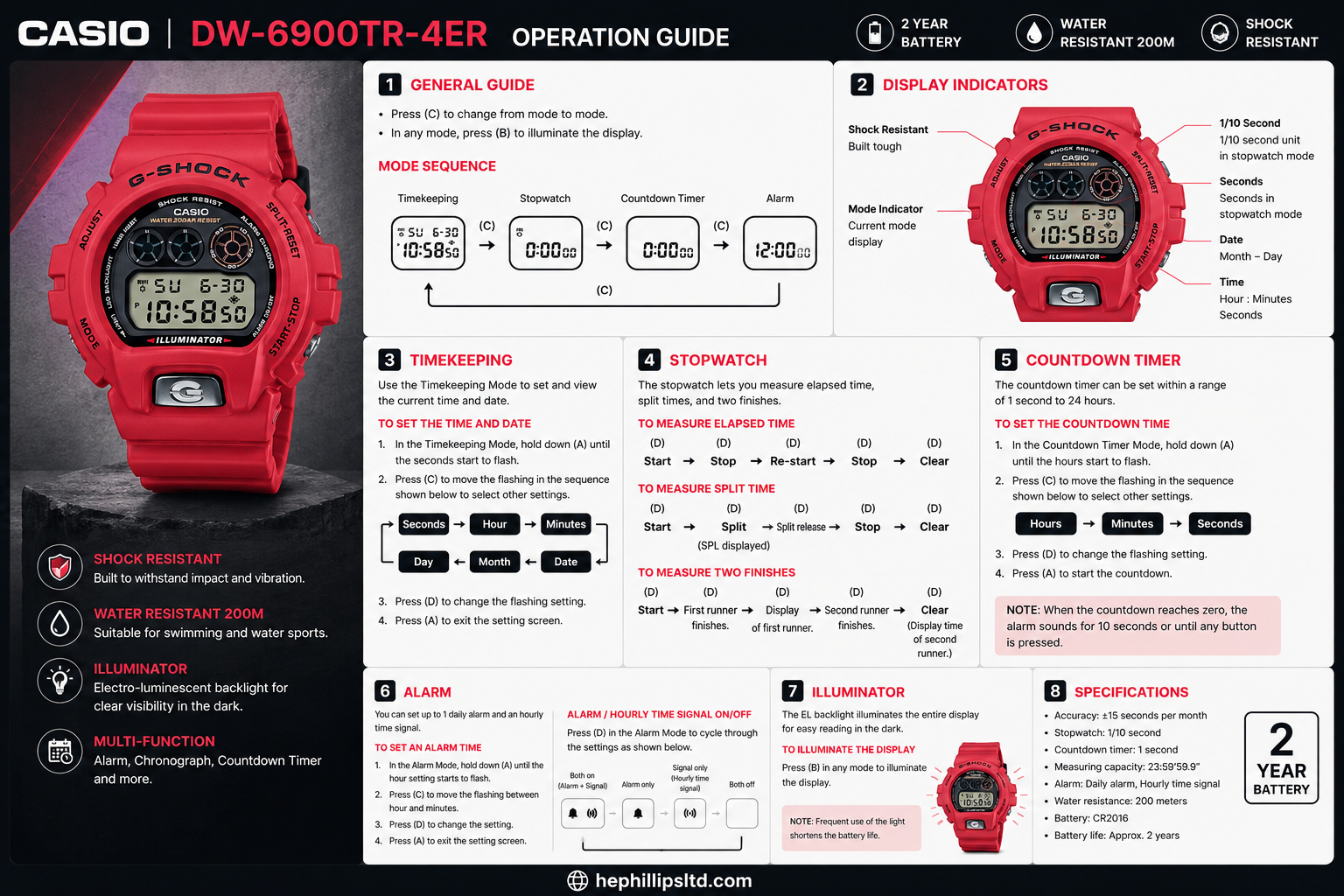
Figure 1.0: Casio DW-6900TR-4ER Operation Guide.
View Official Factory Manual (PDF)
20 Technical FAQs: Engineering & Asset Management
Case Architecture & Shock Engineering
1. How does the hollow case design protect Module 3230 from impact?
The internal electronic module is not fixed rigidly to the outer walls of the watch case. Instead, it is suspended at several small contact points inside a multi-layered polymer bracket, separated by air buffers. When an impact occurs on the outer polyurethane bezel, the energy travels around the exterior structure rather than directly striking the quartz oscillator or liquid crystal layers, minimizing structural deformation.
2. What specific role do the raised bezel elements play in protecting the dial?
The outer resin bezel has raised upper and lower borders that project forward beyond the surface plane of the hardened mineral glass crystal. This geometry ensures that if the watch falls face-down onto a flat surface, the kinetic energy is absorbed by the flexible polymer bumper before it can contact the glass. This configuration prevents face scratches and limits the risk of impact fractures on the crystal.
3. Why is polyurethane resin chosen for the outer case over rigid metals?
Polyurethane resin exhibits high elasticity and damping properties, meaning it deforms slightly under dynamic loads to absorb and disperse impulsive forces. Metals like steel or aluminum pass impact energy directly through to the interior unless isolated by separate dampening rings. Resin keeps the total weight at 67.0g, which lowers the mass and reduces the overall kinetic energy generated during a drop.
4. How do the brass internal thread inserts prevent case-back strip-out?
The four securing screws that clamp down the 316L stainless steel back-plate pass through the steel hole and thread directly into machined brass cylinder inserts. These inserts are molded into the resin body during manufacturing. This construction lets technicians remove the plate for battery changes without wearing away the softer plastic resin threads, which would compromise the seal over time.
Module Performance & Circuit Logic
5. What is the frequency tolerance profile of the internal quartz crystal?
The module relies on a tuning-fork-shaped quartz crystal resonator vibrating at a nominal frequency of 32,768 Hz. Under standard laboratory temperature conditions (ranging from 5°C to 35°C), the timing circuit regulates the pulse steps to maintain an accuracy profile within +/- 15 seconds per month. This baseline ensures precise timekeeping without the day-to-day fluctuations found in mechanical escapements.
6. How does the auto-calendar function calculate changing month lengths?
The integrated circuit inside Module 3230 contains a pre-programmed calendar matrix that automatically adjusts the date display for short months (30 days) and standard months (31 days). It also calculates the leap year sequence for February (29 days) through the year 2099. This eliminates the manual correction steps required at the end of the month on standard analog date wheels.
7. What is the current draw profile when using the flash alert feature?
The flash alert option connects the acoustic piezo buzzer driver with the electroluminescent backlighting line. When a countdown or alarm threshold is met, the circuit sends synchronized pulses to both outputs. While this combined activation temporarily increases current draw from the micro-amp level up to several milli-amps, the short 20-second duration keeps overall battery drain within manageable design parameters.
8. How does the module handle voltage changes as the battery nears depletion?
Module 3230 uses a voltage regulator circuit to keep internal timing logic stable as the lithium cell drops from its initial 3.0V toward its cutoff threshold. Even if the display elements dim or the audio alarm volume drops due to lower cell voltage, the quartz divider circuit keeps running accurately until the cell drops below its minimum operating voltage.
Display Metrics & Visual Logic
9. What functional data do the three segmented display circles track?
In standard timekeeping mode, the left and center circular graphic displays track 5-second and 10-second intervals sequentially by filling their segments in a clockwise direction. The rightmost circular window tracks individual single seconds in a 10-segment loop. When switched to chronographic mode, these windows represent sub-second or multi-second counters, providing a real-time visual breakdown of active timing operations.
10. How does the Twisted Nematic (TN) liquid crystal display function in sunlight?
The display panel uses a Twisted Nematic liquid crystal layout positioned between two linear polarizing filters. Ambient light passes through the top filter, moves through the crystal matrix, reflects off the rear foil surface, and returns to the user's eye. In bright sunlight, this reflective display gains contrast, which avoids the screen washout common with emissive OLED or LCD screens.
11. What is the structural technology behind the uniform EL backlight?
The electroluminescent panel uses a thin layer of phosphorus material spread between two conductive sheets. When you press the front button, an internal transformer sends an alternating current through the layer, causing the phosphorus atoms to emit a uniform blue-green light across the entire display area. This approach provides more even lighting than standard side-mounted LED bulbs.
12. Why do the LCD segments remain readable at wider viewing angles?
The factory limits the thickness of the fluid layer inside the liquid crystal panel to keep the cell gap uniform. This design reduces light scattering within the display stack, allowing users to read the digital time display from sharp angles. This is useful during high-vibration activities or when the watch cannot be turned directly toward the face.
Hydrostatic Integrity & Environmental Care
13. What is the structural significance of the ISO 22810 20 Bar pressure rating?
This certification means the watch housing can withstand a static pressure level of 20 atmospheres without structural leakage. It confirms the sealing rings around the buttons, crystal, and case-back can handle the pressures associated with surface swimming, maritime transport, and recreational water sports, exceeding the sealing performance of standard daily-wear watches.
14. Why should you avoid pressing the pusher buttons while underwater?
Each pusher shaft uses double synthetic nitrile rubber O-ring seals to block water entry. Pressing a button moves the shaft inward through the sealing chamber. If done while submerged, the changing pressure can allow micro-droplets of water to slip past the outer ring into the case, potentially introducing internal humidity that can harm the electronic components.
15. How do thermal shocks affect the internal humidity level of the watch?
Moving from warm air into cold water drops the temperature of the watch case quickly, causing any trace moisture trapped inside during assembly or service to condense on the inner surface of the crystal. If a light mist forms and disappears quickly when temperatures stabilize, the seals are intact. If heavy water droplets remain, it indicates the moisture barrier has been breached.
16. What maintenance steps are required to preserve the 200m water seal?
The synthetic nitrile gaskets naturally lose flexibility and flatten over time from compression and ozone exposure. To maintain the 20 Bar moisture barrier, technicians should inspect the main case seal and button O-rings every 24 months. Replacing worn gaskets and applying fresh silicone grease helps ensure the housing maintains its original pressure rating.
Component Longevity & Service Logistics
17. How does the resin strap design protect the case lug anchor pins?
The polyurethane resin strap is molded with pre-curved ends that rest against the outer housing walls near the lugs. This shape acts as a built-in stopper that prevents the strap from pulling too far backward. By stopping excessive leverage, the strap reduces bending stress on the stainless steel spring bars inside the lugs, lowering the risk of pin failure under heavy loads.
18. What cleaning steps help prevent resin degradation on the burning red finish?
Sweat, skin oils, and salt residue can gradually dry out the protective gloss layer on the polyurethane resin finish. We recommend rinsing the watch exterior under clean, lukewarm water after exposure to marine environments. Gently wiping it down with a soft microfiber cloth removes debris from the bezel grooves without scratching the glossy surface.
19. Is the resin bezel assembly replaceable if it gets damaged?
Yes, the modular case design allows you to separate the outer resin bezel from the primary inner housing structure by removing the side alignment screws. If the outer shell becomes deeply scratched or gouged, a watchmaker can install a replacement bezel unit. This restores the watch's appearance and protective bumpers without requiring you to replace the core timing module or water seals.
20. How does the 316L caseback plate protect against skin irritation?
Grade 316L stainless steel contains high amounts of chromium and molybdenum, which form a stable, protective oxide layer on the metal surface. This alloy composition keeps nickel ions bound tightly within the metal matrix, preventing them from leaching out. This reduces the risk of skin reactions for users with nickel sensitivities during long periods of active wear.
© 2026 H.E. Phillips Ltd - Your Official Authorised Fine Jewellery Specialist. All Technical Data verified for accuracy.
Related Products

DW-5600BBR-1ER
- DW-5600BBR-1ER..

Casio AE-1000W-1A2VEF World Time 10-Year Battery Digital Sport Watch
- Casio AE-1000W-1A2VEF World Time 10-Year Battery Digital Sport Watch | Technical Analysis | H.E. Phi..

Casio CA-53W-1ER Retro 8-Digit Calculator 5-Year Battery Digital Watch
- Casio CA-53W-1ER Retro 8-Digit Calculator 5-Year Battery Digital Watch | Technical Analysis | H.E. P..

Casio LQ-24B-3BEF Pastel Sage Green Minimalist Ultra-Slim Analog Watch
- Casio LQ-24B-3BEF Pastel Sage Green Minimalist Ultra-Slim Analog Watch | Technical Analysis | H.E. P..

Casio G-Shock DW-6900U-1ER Updated Classic Triple Graph Digital Watch
- Casio G-Shock DW-6900U-1ER Updated Classic Triple Graph Digital Watch | Technical Analysis | H.E. Ph..
GA-900-1AER
- GA-900-1AER..

G-SHOCK Heritage Series: Original Spirit Reborn GA-110RL-1AER
- Casio G-SHOCK GA-110RL-1AERThe Casio G-SHOCK GA-110RL-1AER is a robust and versatile analog-digital..

Casio Baby-G BG-169PB-2ER Pastel Blue Beach Colors 200m Water Resistant Watch
- Casio Baby-G BG-169PB-2ER Pastel Blue Beach Colors 200m Water Resistant Watch | Technical Analysis |..

Casio MQ-24B-3BEF Pastel Sage Green Unisex Minimalist Analog Watch
- Casio MQ-24B-3BEF Pastel Sage Green Unisex Minimalist Analog Watch | Technical Analysis | H.E. Phill..

Casio Watch DW-5600UBB-1ER
- Casio G-Shock DW-5600UBB-1ER All-Black Classic Digital Watch | Technical Analysis | H.E. Phillips Lt..

Casio Baby-G BG-169PB-4ER Pastel Pink Beach Colors 200m Water Resistant Watch
- Casio Baby-G BG-169PB-4ER Pastel Pink Beach Colors 200m Water Resistant Watch | Technical Analysis |..

Casio AE-2100W-4AVEF World Time 10-Year Battery 200m Water Resistant Watch (Orange)
- Casio AE-2100W-4AVEF World Time 10-Year Battery 200m Water Resistant Watch (Orange) | Technical Anal..

Casio F-91WC-2AEF Retro Pastel Blue 7-Year Battery Digital Watch
- Casio F-91WC-2AEF Retro Pastel Blue 7-Year Battery Digital Watch | Technical Analysis | H.E. Phillip..

Casio A168WG-9EF Vintage Gold EL Backlight Digital Watch
- Casio A168WG-9EF Gold Vintage Digital Watch | Technical Analysis | H.E. Phillips Ltd { "..