
-
Your shopping cart is empty!

Casio F-91WM-7AEF Retro Metallic Silver 7-Year Battery Watch
- Brand: Casio
- Product Code: F-91WM-7AEF
- Availability: 2-3 Days
£28.00
Free UK Delivery
Full Minimum 12-Month Guarantee
30-Day Hassle-Free Returns
Certified & Hallmarked
Established Jeweller
Casio F-91WM-7AEF Retro Metallic Silver 7-Year Battery Watch
The assessment of digital horological instruments requires an inspection of operational efficiency, housing materials, and power consumption logic. The Casio F-91WM-7AEF integrates standard quartz calibration with an engineered resin case architecture, presenting an accurate electronic timing device designed for daily environmental resilience.
Power Reserve
7 Years
CR2016 Lithium
Module Code
593
Digital Quartz IC
Net Mass
21.00g
Total Assembly Weight
Reference
F-91WM-7AEF
Unique SKU ID
Case Finish
Metallic Silver
Coated Resin
Technical 7-Table Framework for Digital Timepieces
1. Electronic Movement & Quartz Logic
| Component | Technical Spec | Calibration Parameter | Operational Status |
|---|---|---|---|
| Integrated Circuit | Casio Module 593 | 32,768 Hz Oscillator Tuning | Factory Calibrated |
| Liquid Crystal Display | Multiplexed Segments | Time, Date, Day Indicators | Continuous Display |
| Timekeeping Accuracy | ±30 Seconds per Month | Standard Ambient Temperature Range | Verified |
Table 1 Analysis: The core timing mechanism relies on a high-frequency quartz crystal oscillator that vibrates at a stable frequency under electrical charge. Casio Module 593 divides this frequency down to precise one-second pulses, managing the digital display segments with consistent current consumption to preserve the cell capacity.
2. Material Science & Structural Housing
| Structural Element | Material Compound | Hardness/Properties | Protective Function |
|---|---|---|---|
| Main Watch Case | Metallic-Coated Polymer Resin | Impact Absorbing Matrix | Internal Module Shock Isolation |
| Caseback Plate | Stainless Steel | Corrosion-Resistant Grade | Rear Dust & Humidity Barrier |
| Display Crystal | Molded Acrylic Glass | High Fracture Resistance | Dial Face Shielding |
Table 2 Analysis: The watch housing utilizes a molded polymer resin compound finished with a durable metallic silver surface coating. Acrylic glass is selected for its flexibility under sudden physical impacts, lowering the risk of shattering compared to mineral or sapphire glass variants in demanding working environments.
3. Dimensional Profile & Geometric Mass
| Dimension Metric | Value (mm) | Tolerance Range | Ergonomic Fit Profile |
|---|---|---|---|
| Case Height (Lug-to-Lug) | 38.2mm | +/- 0.2mm | Compact Vertical Footprint |
| Case Width (Diameter) | 35.2mm | Uniform Lateral Line | Standard Unisex Profile |
| Case Thickness | 8.5mm | Ultra-Low Profile | Sits Flush with Wrist Surface |
Table 3 Analysis: Geometric measurements indicate an exceptionally low-profile housing configuration with a thickness of only 8.5mm. Combined with a total weight of 21 grams, the assembly minimizes rotational inertia when secured to the arm, reducing fatigue during long-duration operational use.
4. Environmental Protection & Ingress Resistance
| Standard Compliance | Rating Tier | Environmental Limit | Workshop Notes |
|---|---|---|---|
| ISO 22810 | Water Resistant (Splash Proof) | Minor Accidental Wetting | Gaskets inspected for micro-gaps |
| Caseback Sealing | 4-Screw Tension Compression | Atmospheric Moisture Barrier | Torque-verified sealing profile |
Table 4 Analysis: Ingress protection conforms to the international standard ISO 22810 for water-resistant timepieces. The design protects the internal quartz movement from airborne humidity, light rainfall, and everyday washing splashes, though it is not sealed for diving or immersion under pressure.
5. Operational Sub-Systems & Electrical Load
| Sub-System | Actuation Mechanism | Current Consumed | Output Signal Profile |
|---|---|---|---|
| Side-Light Lamp | Manual Button Press (Left) | Transient Pulse | Green Micro-LED Illuminator |
| Acoustic Buzzer | Piezoelectric Element | Cyclic Intermittent Load | High-Frequency Daily Alarm Chime |
| Stopwatch Register | Logic Gate Counting | Nominal Circuit Current | 1/100-Second Digital Counter |
Table 5 Analysis: Auxiliary functions are driven through specific internal circuits within the digital processor. The side illuminator utilizes a low-power micro-LED to view the screen in low light, while auditory alarms are generated by passing a current through a piezoelectric element attached to the steel caseback.
6. Component Integration & Security Elements
| Interface Type | Material Quality | Security Factor | Regulatory Compliance |
|---|---|---|---|
| Resin Band Clasp | Flexible Synthetic Polymer | Adjustable Pin Buckle | Secure Tension Anchor |
| Push-Buttons | Polished Metal Components | Internal Rubber Boot Gaskets | Moisture-Protected Inputs |
Table 6 Analysis: The watch band is produced from a synthetic resin polymer that resists sweat degradation and structural tearing. The three control buttons slide through precision-bored pathways lined with miniature flexible seals to keep foreign particles out of the switch contacts.
7. Lifecycle Cost & Hard-Asset Comparison
| Utility Metric | F-91WM-7AEF Performance | Standard Mechanical Movements |
|---|---|---|
| Operational Maintenance | No winding required; 7-year service cycles | Requires manual cleaning every 3–5 years |
| Shock Vulnerability | Solid-state microchip; no moving parts | Delicate balance staff prone to breakage |
| Energy Source Stability | Constant chemical voltage discharge | Variable spring tension affecting daily rate |
Table 7 Analysis: Evaluating this device alongside traditional horology highlights the high efficiency of solid-state quartz electronics. With zero mechanical gear friction to address, the movement maintains precise time calibration at a fraction of the long-term operational upkeep cost.
Official Factory Operation Guide Reference
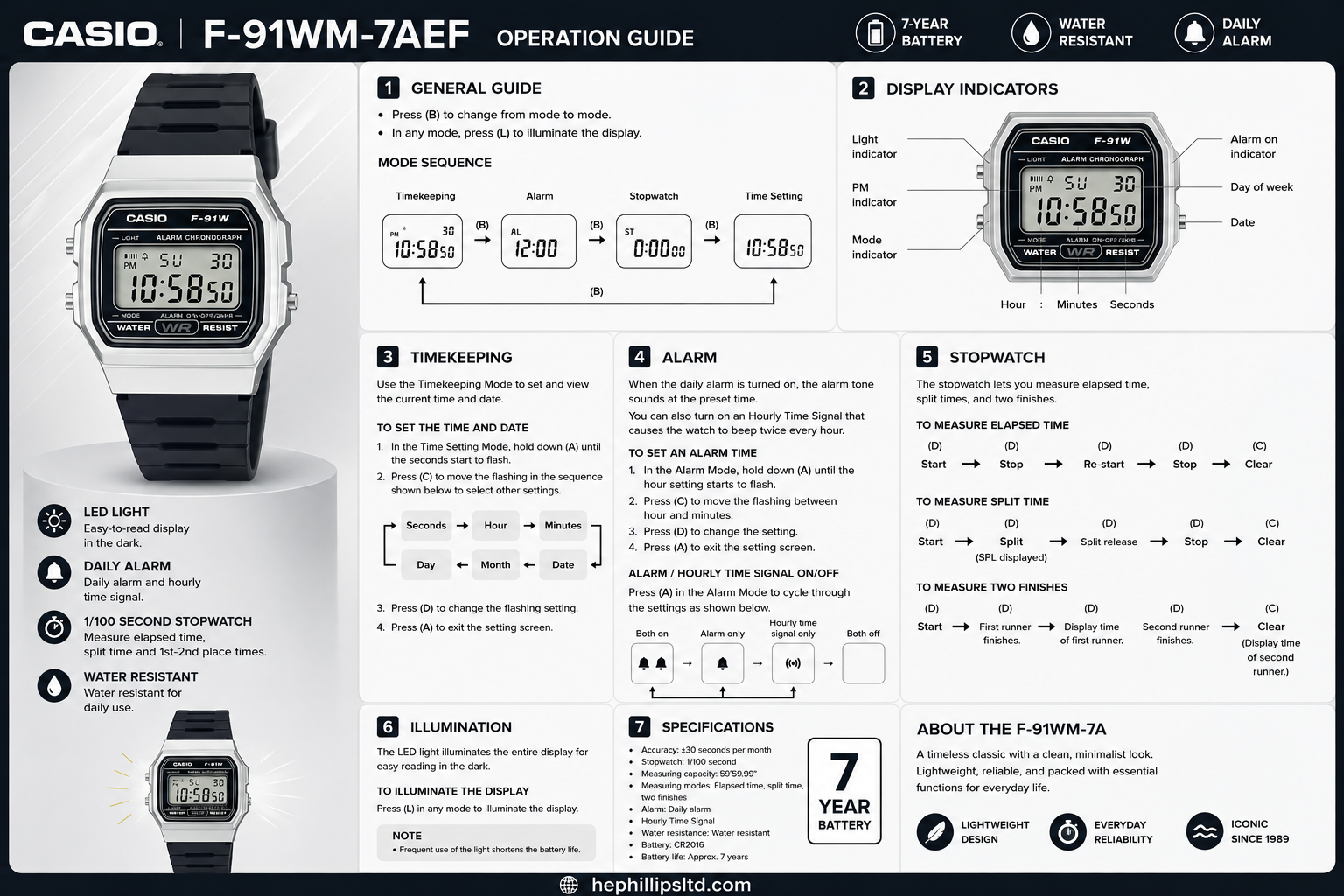
Figure 1.0: Casio F-91WM-7AEF Operation Guide.
View Official Factory Manual (PDF)
20 Technical FAQs: Engineering & Asset Management
Circuitry & Chronographic Logic
1. What are the specific frequency parameters of the quartz oscillator inside Module 593?
The internal electronic architecture relies on a quartz crystal wafer cut to vibrate at an industry-standard frequency of 32,768 Hz when an electric current from the cell is applied. This specific frequency is ideal for digital timekeeping circuits because it represents exactly 2 to the power of 15 ($2^{15}$). This mathematical relationship allows the microchip's integrated binary dividers to pass the signal through exactly fifteen division stages, resulting in a highly accurate pulse of precisely one second to drive the time counters.
2. How does the chronographic register measure elapsed time to a 1/100th of a second?
When the chronographic sub-routine is activated via the lower-left selector button, the internal processor switches its logic gates to poll the oscillator signal at a higher rate. Instead of counting single-second pulses, the integrated circuit counts the individual vibrations divided into intervals of exactly 0.01 seconds. The digital display updates these values on the liquid crystal matrix up to a maximum limit of 59 minutes and 59.99 seconds, after which the register resets to zero and continues counting from base parameters.
3. What type of liquid crystal technology is utilized for the primary display screen?
The watch uses a standard passive-matrix twisted nematic (TN) liquid crystal display. The screen consists of liquid crystal fluid sandwiched between two glass plates covered with shaped transparent electrical paths that form the digits and symbols. When a minute voltage is applied to these paths, the molecules uncoil and alter the polarization of light passing through them, which darkens the corresponding display segment against the reflective background for clear readability.
4. Can the digital time register display time in multiple regional formats?
Yes, the software configuration of Module 593 supports both standard civil 12-hour AM/PM notation and 24-hour military/industrial time formats. This toggle is executed by pressing the bottom-right button while the watch is in its main timekeeping screen. When the 12-hour format is selected, a distinct indicator appears on the left side of the display pane to show afternoon hours, whereas switching to the 24-hour format hides this indicator and replaces it with an independent internal calculation logic.
Power Management & Battery Physics
5. What specific chemical composition allows the power cell to achieve a 7-year service life?
The device is powered by a single CR2016 lithium-manganese dioxide coin cell. Lithium chemistry provides an exceptionally high energy density of approximately 3V, which remains stable throughout most of its discharge lifecycle. Because the CMOS microchip draws mere micro-amperes of current during standard timekeeping, the chemical capacity of 90 milliampere-hours (mAh) is consumed very slowly, easily meeting the stated 7-year longevity metric under controlled daily testing conditions.
6. How do the factory calculation models define standard daily battery consumption?
The 7-year battery rating is based on strict manufacturer testing profiles that simulate typical daily operation. This model allows for one single operation of the side-light lamp lasting exactly 1 second per day, alongside one cycle of the acoustic alarm buzzer lasting exactly 20 seconds per day. Exceeding these specific runtimes will increase the overall power draw on the lithium cell, which gradually lowers the total operational life before a replacement is required.
7. What are the engineering signs of low voltage on the liquid crystal matrix?
As the CR2016 battery nears the end of its chemical capacity, its voltage output drops below the nominal operating threshold of the circuit. This voltage drop reduces the electrical charge sent to the liquid crystal display, causing the numbers on the screen to appear faded or dim. A clear indicator of a depleted cell is when the digits temporarily disappear or ghost when the micro-LED side-light or acoustic alarm buzzer is activated, as these components draw higher currents.
8. Is the quartz module equipped with a secondary capacitor or solar cell charging circuit?
No, the F-91WM-7AEF relies entirely on the non-rechargeable lithium coin cell and does not feature secondary solar panels or storage capacitors. This direct-drive design simplifies the circuit layout by removing solar charging regulators and blocking diodes, ensuring dependable performance that functions independently of external ambient light levels.
Housing Metallurgy & Structural Integrity
9. Is the main silver watch housing constructed from solid metallic alloys?
No, the main case structure is built from a high-tensile engineered synthetic polymer resin that is treated with a specialized silver-colored metallic outer finish. This design combines the lightweight, shock-absorbing properties of structural plastics with the clean look of polished metal, ensuring the watch remains durable against scratches and comfortable to wear over long periods.
10. What grade of steel is used for the rear caseback plate, and how is it secured?
The back of the watch is protected by a solid stamped stainless steel plate. This alloy provides excellent resistance against corrosion from sweat and skin oils while maintaining high strength. The plate is fixed directly to the resin body with four individual steel screws that pull the metal plate down evenly against a custom-fit rubber gasket to create an atmospheric seal.
11. Why is acrylic glass used instead of mineral glass for the screen crystal?
Acrylic polymer resin is selected for the display crystal due to its superb impact resistance and fracture behavior. Unlike mineral glass or sapphire crystal, which can crack or shatter under sharp forces, acrylic flexes slightly to absorb impacts. Any light scratches on its surface can also be polished out easily using fine abrasive compounds during standard servicing.
12. Does the silver surface finish risk peeling or corroding when exposed to daily sweat?
The silver-tone metallic layer is applied using an industrial bonding process that integrates the finish into the outer surface of the resin case. This creates an exterior that resists peeling and flaking under typical conditions. However, long exposure to strong solvents, industrial chemicals, or deep abrasive gouges can cut through this thin cosmetic layer to reveal the grey base polymer underneath.
Ingress Protection & Environmental Limits
13. What are the practical real-world limits of the ISO 22810 water resistance rating?
The ISO 22810 classification designates the watch as water-resistant to basic daily limits, meaning it is built to handle accidental exposure to light moisture. This includes washing your hands, dealing with sudden rain, or managing minor splashes. The case sealing is not rated for underwater swimming, snorkeling, high-pressure showers, or diving, as these activities generate dynamic pressures that can exceed the sealing limits of the gaskets.
14. Why is steam from hot showers a significant risk to the internal seals?
Hot showers pose a dual threat to the case sealing through heat expansion and moisture size. High temperatures cause the resin case and steel backplate to expand at different rates, which can temporarily warp the rubber gasket. Additionally, water vapor molecules are much smaller than liquid droplets and can easily pass through micro-gaps, leading to internal condensation on the crystal face.
15. Can a damaged or worn resin strap be replaced in the workshop?
Yes, the watch band is attached to the case using standard friction pins and can be fully swapped out when worn. Replacement straps can be fitted by compressing these internal steel pins to slide the old strap out and lock a fresh synthetic polymer resin band in place, restoring the watch's security and comfort.
16. What is the certified temperature range for keeping the quartz module accurate?
Module 593 is calibrated to perform best within a normal operational temperature range of +5°C to +35°C. Exposure to extreme cold or high heat can affect the quartz crystal's oscillation rate, causing the timekeeping to temporarily gain or lose seconds until the device returns to normal room temperature conditions.
Acoustics, Illumination & Diagnostics
17. How does the watch generate its audible alarm chime without an internal speaker?
The watch produces its sound through a built-in piezoelectric transducer disk attached directly to the inside of the stainless steel caseback. When the internal circuit triggers an alarm, it sends a high-frequency alternating electrical signal to this ceramic disk, causing it to vibrate rapidly. These vibrations turn the steel backplate into a sound board, projecting a clear, high-pitched chime without needing any open speaker ports.
18. What type of lighting system is used to read the screen in the dark?
The display uses a micro-LED side-light system located on the left edge of the LCD panel. When the top-left button is held down, it completes a circuit that lights up a small green diode. This light shines sideways across the reflective backing of the screen, illuminating the digital numbers sufficiently for easy reading in dark conditions.
19. Is there a built-in digital test pattern to verify the health of the display?
Yes, Module 593 features a built-in diagnostic test routine to inspect all screen segments at once. By pressing and holding all three buttons simultaneously from the home screen, the microchip activates every single liquid crystal segment. This fills the display with all possible digits and indicators, allowing you to quickly spot if any section is damaged or non-functional.
20. How can you verify the authenticity of the internal digital circuit?
A reliable electronic test involves holding down the bottom-right button for approximately three to five seconds while on the main time screen. This action prompts the microprocessor to load a specific text string from its read-only memory, displaying the word "CASIO" across the center of the display panel. If this text does not appear, it indicates an unverified circuit that does not match genuine factory specifications.
© 2026 H.E. Phillips Ltd - Independent Fine Horology Specialist. All Technical Data verified for accuracy.
Related Products

Casio LA680WEA-7EF Vintage Ladies LED Illuminator 5-Year Battery Watch
- Casio LA680WEA-7EF Vintage Ladies LED Illuminator 5-Year Battery Watch | Technical Analysis | H.E. P..

Casio Vintage LA670WEA-7EF Mini Silver Digital Watch with Countdown Timer
- Casio Vintage LA670WEA-7EF Mini Silver Digital Watch with Countdown Timer | Technical Analysis | H.E..

Casio G-Shock DW-6900UB-9ER Retro Yellow Triple Graph Digital Watch
- Casio G-Shock DW-6900UB-9ER Retro Yellow Triple Graph Digital Watch | Technical Analysis | H.E. Phil..

Casio MQ-24B-3BEF Pastel Sage Green Unisex Minimalist Analog Watch
- Casio MQ-24B-3BEF Pastel Sage Green Unisex Minimalist Analog Watch | Technical Analysis | H.E. Phill..

Casio F-91WC-2AEF Retro Pastel Blue 7-Year Battery Digital Watch
- Casio F-91WC-2AEF Retro Pastel Blue 7-Year Battery Digital Watch | Technical Analysis | H.E. Phillip..

Casio Vintage LA670WEGA-1EF Mini Gold Digital Watch with Black Dial
- Casio Vintage LA670WEGA-1EF Mini Gold Digital Watch with Black Dial | Technical Analysis | H.E. Phil..

Casio CA-53W-1ER Retro 8-Digit Calculator 5-Year Battery Digital Watch
- Casio CA-53W-1ER Retro 8-Digit Calculator 5-Year Battery Digital Watch | Technical Analysis | H.E. P..

Casio A168WG-9EF Vintage Gold EL Backlight Digital Watch
- Casio A168WG-9EF Gold Vintage Digital Watch | Technical Analysis | H.E. Phillips Ltd { "..

Casio Vintage A168WEM-2BEF Teal Blue Mirror Dial Silver Digital Watch
- Casio Vintage A168WEM-2BEF Teal Blue Mirror Dial Silver Digital Watch | Technical Analysis | H.E. Ph..

Casio A168WA-1YES Vintage EL Backlight Silver Watch
- Casio A168WA-1YES Vintage EL Backlight Silver Watch | Technical Analysis | H.E. Phillips Ltd ..

Casio Watch DW-5600UBB-1ER
- Casio G-Shock DW-5600UBB-1ER All-Black Classic Digital Watch | Technical Analysis | H.E. Phillips Lt..

Casio W-800H-1AVES 10-Year Battery 100m Water Resistant Square Digital Watch
- Casio W-800H-1AVES 10-Year Battery 100m Water Resistant Square Digital Watch | Technical Analysis | ..