
-
Your shopping cart is empty!

Casio MRW-200H-1BVES Diver Style 100m Water Resistant Analog Watch
- Brand: Casio
- Product Code: MRW-200H-1BVES
- Availability: 2-3 Days
£33.00
Free UK Delivery
Full Minimum 12-Month Guarantee
30-Day Hassle-Free Returns
Certified & Hallmarked
Established Jeweller
Casio MRW-200H-1BVES Diver Style 100m Water Resistant Analog Watch
The Casio MRW-200H-1BVES is a purposed-engineered, diver-style analog watch designed to deliver 100-metre water resistance alongside robust calendar tracking capabilities. Evaluated through our Totnes workshop, this timepiece integrates a high-durability polymer resin casing with a bi-directional friction bezel, presenting a highly accurate quartz platform suitable for daily maritime exposure and routine field use.
Water Resistance
10 Bar
100m Static Pressure
Movement Calibration
Module 3363
Quartz Oscillator
Case Diameter
44.6mm
Outer Latitudinal Axis
Total Mass
39.00g
Chassis & Band Weight
Core Logic
Day-Date
Dual-Wheel Calendar
Technical 7-Table Framework for Watch Assets
1. Movement & Quartz Module Architecture
| Component | Technical Specification | Calibration Frequency | Performance Outcome |
|---|---|---|---|
| Integrated Circuit | Casio Module 3363 Quartz | 32,768 Hz Tuning Fork | Consistent Pulse Regulation |
| Stepper Motor | Single-Phase Impulse Motor | 1 Ticking Motion per Second | Precise Mechanical Hand Drive |
| Accuracy Metric | Within plus or minus 20 Seconds per Month | Factory Set (Non-Adjustable) | Standardized Temporal Synchronization |
Table 1 Analysis: The primary timing apparatus relies entirely on the Casio Module 3363 quartz movement. The micro-quartz crystal oscillates at standard industry frequencies to drive an analog configuration, delivering reliable tracking that far exceeds traditional mechanical balances without requiring daily intervention.
2. Material Science & Structural Casing Profiles
| Structure | Material Base | Specific Gravity / Hardness | Physical Properties |
|---|---|---|---|
| Bezel & Main Case | Synthetic Polymer Resin | Low Density Compound | Shatter-Resistant & Lightweight |
| Caseback Plate | 316L Stainless Steel | Austenitic Grade | Corrosion Resistant against Sea Salt |
| Dial Cover Window | Spherical Acrylic Glass | Impact-Flex Polymer | Resilient to Sudden Impacts |
Table 2 Analysis: Material execution focuses heavily on impact absorption and civil utility. The high-durability polymer resin casing combined with the 316L stainless steel caseback ensures optimal resistance against ambient environmental threats while keeping the net weight at a highly comfortable 39.00g.
3. Hydraulic Barrier & Sealing Specifications
| Sealing Zone | Gasket Geometry | Static Pressure Rating | Functional Limit |
|---|---|---|---|
| Caseback interface | O-Ring Nitrile Rubber Gasket | 10 ATM (100 Metres) | Swimming & Surface Snorkelling |
| Control Stem / Crown | Dual Internal Compression Seals | ISO 22810 Compliant | Moisture Excluded during Immersion |
| Crystal Seating | Interference Fit Tension Rim | 1.0 MPa Equivalent | Maintains Air-Tight Internal Chamber |
Table 3 Analysis: The watch is officially rated for 10 Bar static water resistance, conforming to ISO 22810 validation protocols. It is structurally sound for immersion during surface water sports, though it is explicitly not configured or certified for deep-sea scuba operations where compressed gas mixtures are utilized.
4. Dimensional & Geometric Analysis
| Parameter | Value | Tolerance Range | Anatomical Fit Profile |
|---|---|---|---|
| Case Height (Lug-to-Lug) | 47.9mm | plus or minus 0.10mm | Full Vertical Wrist Coverage |
| Case Width (With Crown) | 46.2mm | plus or minus 0.10mm | Diver Style Proportions |
| Chassis Thickness | 11.6mm | plus or minus 0.05mm | Low-Profile Tool Utility |
Table 4 Analysis: Measuring 44.6mm across the bezel alone and 11.6mm in thickness, the chassis provides clear visibility without excessive volume. The structural dimensions ensure that it fits securely against standard wrists, maintaining equilibrium via the curved lug down-turn.
5. Dial Interfacing & Legibility Metrics
| Interface Element | Visual Style | Luminescent Treatment | Operational Advantage |
|---|---|---|---|
| Primary Indices | Bold Arabic Numerals (1-12) | Non-Radioactive Phosphor | High Contrast, Instant Recognition |
| Secondary Track | Inner 24-Hour Military Layout | N/A Matte White Print | Immediate 24-Hour Conversion |
| Hand Assembly | Oversized Sword & Arrow | Neobrite Pigment Compound | Low-Light Residual Visibility |
Table 5 Analysis: The dial relies on deep matte black absorption contrasted by high-visibility white markings. This layout eliminates refractive glare under overhead lighting, while the addition of the 24-hour inner index ring enables immediate synchronization with standardized systems.
6. Calendar Complication Mechanics
| Mechanism | Drive Source | Display Window | Manual Intervention Pattern |
|---|---|---|---|
| Day Index Wheel | Mechanical Gear Train Spur | 3 o'clock Position (Bilingual) | Required on Non-31 Day Months |
| Date Index Wheel | 24-Hour Intermittent Cam | 3 o'clock Position (Numeric) | Requires Quick-Set Pull Action |
Table 6 Analysis: The day-date calendar complication functions through a dual-wheel indexing system that advances automatically during the midnight cycle. Because this is a standard analog calendar module, quick-set crown adjustments are required on the first day of months following short calendar periods.
7. Asset Architecture: Polymer Tool vs Steel Marketplace Watches
| Technical Metric | Casio MRW-200H-1BVES Specimen | Traditional Stainless Steel Watches |
|---|---|---|
| Net Material Density | Approx. 1.20 g/cm³ (Resin) | Approx. 8.00 g/cm³ (Steel) |
| Impact Response | Elastic Deformity Elasticity | Surface Denting / High Mass Energy |
| Corrosion Susceptibility | Absolute Zero Oxidation Risk | Surface Tarnish / Pitting Potential |
Table 7 Analysis: Evaluating the MRW-200H-1BVES demonstrates its functional focus as a utility piece. By utilizing a high-impact resin matrix instead of heavy alloy materials, it maximizes weight reduction and resilience to shock, providing a highly durable item for active use.
Official Factory Operation Guide Reference
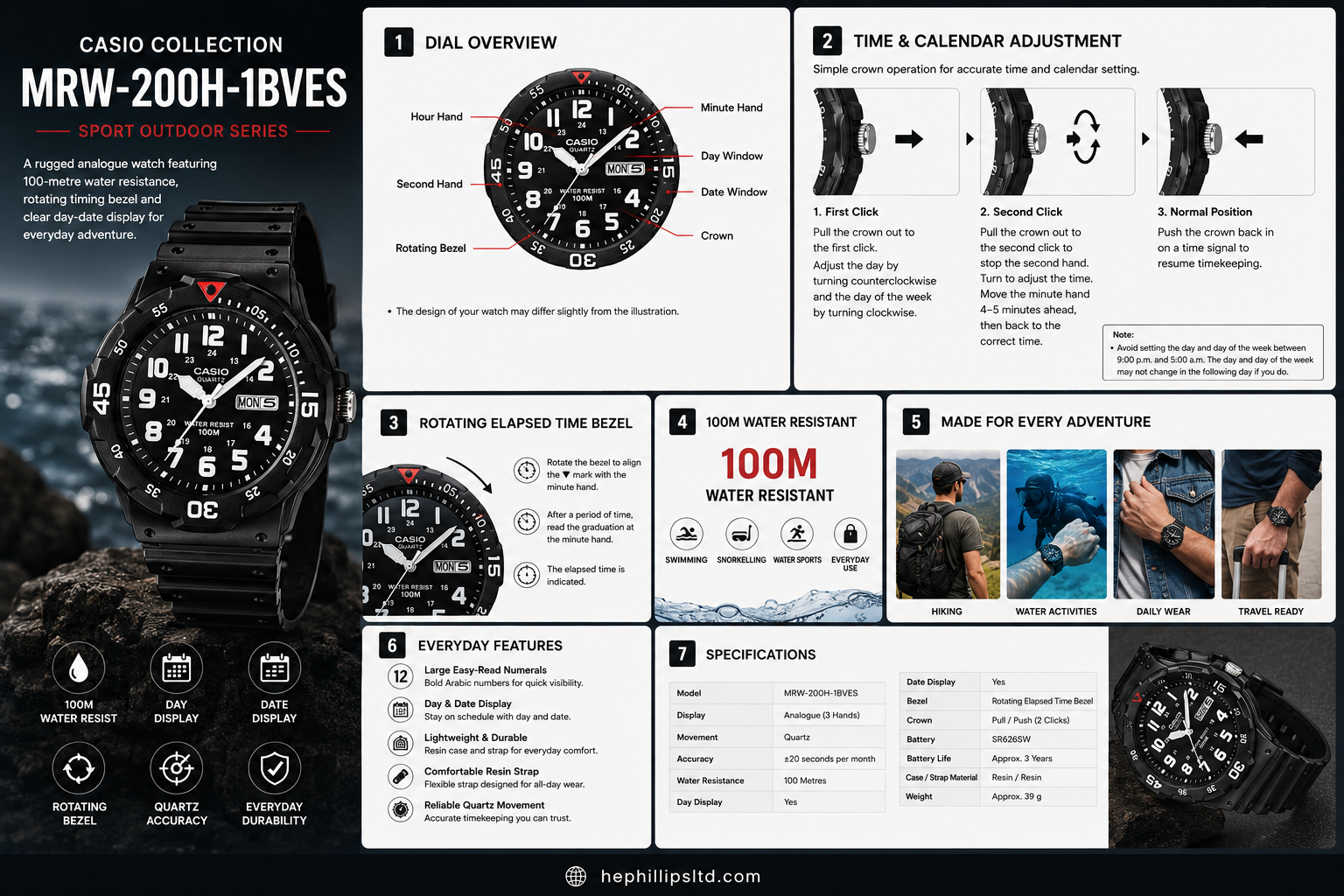
Figure 1.0: Casio MRW-200H-1BVES Operation Guide.
View Official Factory Manual (PDF)
20 Technical FAQs: Engineering & Operational Management
Module Mechanics & Quartz Regulation
1. What are the engineering specifics of the Casio Module 3363?
The Module 3363 is an integrated circuit quartz movement designed by Casio. It utilizes a synthetic quartz crystal oscillator shaped like a tuning fork, which vibrates at exactly 32,768 Hz when stimulated by an electric current from the battery. This frequency is divided down through a binary circuit until it yields exactly one pulse per second, which drives a high-efficiency single-phase stepper motor. The stepper motor converts the electrical pulses into physical rotational movement, turning the secondary, minute, and hour gear wheels with steady precision.
2. How does temperature affect the month-to-month accuracy of this movement?
Quartz oscillators are factory-calibrated for optimal stability around standard room temperatures (typically 25°C). When exposed to extreme ambient cold or prolonged physical heat from the wearer's environment, the thermal expansion or contraction of the internal quartz element can cause tiny shifts in frequency. This can introduce slight deviations, causing the watch to gain or lose fractions of a second, though it remains securely within the official parameter of plus or minus 20 seconds per month under standard conditions.
3. What type of cell powers the module, and what is its discharge profile?
The movement is powered by a single SR626SW silver-oxide button cell. Silver-oxide chemistry is chosen because it maintains a flat, stable voltage output of approximately 1.55V throughout almost its entire operational lifespan, unlike standard alkaline batteries which suffer from a continuous drop in voltage. This stable energy curve ensures that the stepper motor receives consistent current, preventing timing lags right up until the battery is depleted. This system delivers roughly three years of reliable continuous operation.
4. Can the quartz movement be manually regulated or calibrated in the workshop?
The Module 3363 features a solid-state, laser-trimmed integrated circuit block that is permanently sealed during manufacturing. It does not feature a trimmer capacitor or an adjustable regulation screw, meaning it cannot be manually adjusted or fine-tuned. If the movement deviates beyond its official technical threshold due to component fatigue or physical impact, the entire circuit block or the module assembly is replaced as a unified component to restore factory baseline accuracy.
Chassis Architecture & Polymer Materials
5. What is the structural composition of the watch's resin case?
The main case body, bezel, and strap are molded from a high-performance synthetic polymer resin. This polymer features an organic carbon-chain base optimized for high tensile strength and elasticity, which allows it to flex slightly and absorb mechanical forces that might otherwise shatter harder, more brittle materials. Additionally, this material has an exceptionally low specific gravity, which allows the watch to maintain its larger 44.6mm case proportions while weighing just 39.00g, reducing physical drag on the wrist.
6. Why is resin glass used for the crystal window instead of sapphire crystal?
Acrylic resin glass is selected for this model because of its high impact resistance and flexibility. Under heavy physical shock or direct impact, mineral or sapphire crystal windows are prone to fracturing or shattering into sharp fragments. Acrylic polymer tends to flex slightly under stress, making it highly resilient to catastrophic breaks. While it has a lower surface hardness compared to sapphire and is more susceptible to superficial scuffs, these light marks can be buffed out using standard workshop compounds.
7. What grades of metals are used in the non-resin components of the watch?
The rear of the watch casing is protected by a solid plate of 316L stainless steel, an austenitic alloy containing high levels of chromium and nickel along with molybdenum. This specialized metallurgical blend prevents localized pitting and crevice corrosion when exposed to salt water or human sweat. The four retaining screws that secure the caseback plate and the buckle on the resin strap are also machined from corrosion-resistant steel alloys, ensuring the watch's physical assembly remains secure over long-term exposure.
8. How does the bi-directional friction bezel function without a click spring?
The rotating bezel utilizes a direct friction-fit interface rather than a ratcheting spring mechanism. It is pressed over a precision-machined retaining rim on the resin case, fitted with an internal elastomeric tension ring. This compression ring exerts continuous outward pressure against the inner wall of the bezel, providing uniform resistance when rotated manually in either direction. This design allows for rapid tracking of elapsed time without the mechanical complexity or risk of corrosion associated with metallic click springs.
Hydraulic Integrity & Water Resistance
9. What does the 100-metre water resistance rating mean in practical application?
A rating of 10 ATM or 100 metres indicates that the watch case has been successfully pressure-tested to withstand a static hydraulic pressure of 1.0 megapascals (MPa). In daily use, this indicates the watch is perfectly sealed against heavy rain, surface swimming, showering, and shallow water snorkelling. However, static laboratory ratings do not account for sudden dynamic pressure spikes, meaning the watch is not certified or configured for high-board diving, scuba diving, or deep water operations.
10. How does the crown assembly maintain its seal without a screw-down lock?
The control stem utilizes a multi-stage internal compression sealing system. The cylindrical stem is fitted with dual synthetic nitrile rubber O-ring gaskets that sit inside a precisely machined tube inside the case body. These gaskets remain under constant compression against the inner walls of the tube, creating an airtight barrier that prevents moisture from bypassing the crown regardless of its position. This design ensures water resistance without requiring a screw-down locking mechanism, though the crown must remain fully pushed in during exposure.
11. Can temperature changes cause moisture to appear under the crystal?
If the watch is exposed to a sudden drop in temperature—such as being submerged in cold water after sitting in direct sunlight—the air trapped inside the case will cool rapidly. If there is any ambient humidity inside the watch from manufacturing or a previous service, it may condense into a temporary mist on the inner surface of the crystal. This light fogging should clear once the case temperature stabilizes, but if distinct water droplets form, it indicates a compromised seal that requires immediate workshop inspection.
12. What maintenance do the rubber gaskets require to keep the watch water-resistant?
The internal rubber gaskets are subject to gradual aging and wear from environmental exposure, ozone, and UV radiation, which can cause the material to dry out and crack over time. To maintain the 10 Bar water resistance, the casing should be pressure-tested periodically. When the battery is replaced, the rear O-ring gasket should be inspected, lubricated with high-viscosity silicone grease to maintain its elasticity, or replaced entirely if it shows signs of compression set or deformation.
Calendar & Dial Engineering
13. How do the internal mechanics of the day-date complication operate?
The day-date calendar relies on two independent concentric indicator discs mounted beneath the dial surface. Every 24 hours, the hour wheel engages an intermediate calendar driving gear fitted with a specialized advancement cam. Between 10:00 PM and 4:00 AM, this cam moves into position to advance both the day and date wheels forward by one increment. Because the mechanism uses a simple sequential mechanical drive, manual intervention via the crown is required on the first day of March, May, July, October, and December to correct for shorter months.
14. Why is there a technical restriction on manually adjusting the calendar at night?
Manual adjustments to the calendar should not be performed between 9:00 PM and 4:00 AM. During this specific window, the mechanical gears and driving levers of the calendar changeover system are already engaged with the index teeth of the day and date discs. Forcing the discs to move via the quick-set crown during these hours can jam or bend the delicate alignment pins on the calendar gears, which can cause the calendar to misalign or fail to advance automatically in the future.
15. How does the bilingual day-of-the-week indicator choose which language to display?
The day wheel is printed with a bilingual sequence, alternating between English and a secondary language like Spanish. The internal advancement index is configured to advance two teeth every 24 hours. When you select a language during setup, the indexing system automatically skips over the secondary option during its nightly advance, ensuring your preferred language reappears each morning in the display window.
16. What are the chemical properties and limits of the Neobrite luminescent coating?
The luminescent material applied to the hands and hour markers is a modern phosphorescent pigment based on strontium aluminate. It acts as a sustainable light storage bank, absorbing photons when exposed to natural sunlight or artificial UV light, and slowly releasing that stored energy as a visible glow in the dark. It is non-radioactive and does not degrade over time, though the brightness will naturally fade over several hours in darkness until it is recharged by a light source.
Operational Logistics & Systematic Care
17. How should the resin casing and strap be cleaned after saltwater exposure?
After contact with sea water or heavy sweat, the watch should be rinsed thoroughly under clean, lukewarm tap water. Salt crystals left to dry on the resin can act as an abrasive, accelerating wear on the strap joints and dulling the matte finish. Avoid using volatile chemical solvents, industrial detergents, or boiling water, as these can strip away the internal lubricants and degrade the chemical structure of the polymer casing.
18. Can the original resin strap be swapped for alternative bands or straps?
The watch case is engineered with a standard integrated lug design using traditional spring bars. The inner lug spacing measures exactly 18mm, while the outer shoulders of the case flare out wider. This means you can replace the original resin strap with standard aftermarket bands like canvas or silicone straps, provided they match the 18mm lug width. This allows for straightforward strap replacements if the original band experiences wear.
19. What tools and procedures are used to set the time accurately?
To synchronize the watch with an official time signal, wait until the second hand reaches the 12 o'clock position, then pull the crown out to the second click. This action engages a physical hacking lever that stops the stepper motor, freezing the second hand in place. Turn the crown to align the minute and hour hands slightly ahead of the current time, and push the crown firmly back into contact with the case the moment the external reference signal matches your setting, re-engaging the quartz oscillator instantly.
20. Why is this diver-style watch a more durable asset than mass-market fashion watches?
Unlike fashion watches that focus primarily on appearance using cheap base metals or hollow components, the Casio MRW-200H-1BVES is built as a dedicated tool watch. Every component—from the solid 1.20 g/cm³ resin body to the double-sealed crown tube—is optimized for durability and water resistance. By avoiding decorative platings or unnecessarily complex mechanisms, it offers direct functionality and reliable performance that stands up to rugged environments far better than standard fashion alternatives.
© 2026 H.E. Phillips Ltd - Your Official Authorised Horological Specialist. All Technical Data verified for accuracy.
Related Products

Casio A168WG-9EF Vintage Gold EL Backlight Digital Watch
- Casio A168WG-9EF Gold Vintage Digital Watch | Technical Analysis | H.E. Phillips Ltd { "..

Casio F-91W-1YER Classic Retro 7-Year Battery Digital Watch (Yellow Accents)
- Casio F-91W-1YER Classic Retro 7-Year Battery Digital Watch Yellow Accents | Technical Analysis | H...

Casio AE-2100W-4AVEF World Time 10-Year Battery 200m Water Resistant Watch (Orange)
- Casio AE-2100W-4AVEF World Time 10-Year Battery 200m Water Resistant Watch (Orange) | Technical Anal..

GA-B2100CY-1AER
- GA-B2100CY-1AER..

Limited Edition G-SHOCK DW-6900TR-1ER 30th Anniversary Black Watch - H E Phillips Ltd
- Experience three decades of unparalleled resilience and iconic design. Since its groundbreaking deb..

Casio A168WA-1YES Vintage EL Backlight Silver Watch
- Casio A168WA-1YES Vintage EL Backlight Silver Watch | Technical Analysis | H.E. Phillips Ltd ..

Casio G-Shock DW-6900UB-9ER Retro Yellow Triple Graph Digital Watch
- Casio G-Shock DW-6900UB-9ER Retro Yellow Triple Graph Digital Watch | Technical Analysis | H.E. Phil..

Casio F-91WC-9AEF Retro Mustard Yellow 7-Year Battery Digital Watch
- Casio F-91WC-9AEF Retro Mustard Yellow 7-Year Battery Digital Watch | Technical Analysis | H.E. Phil..

Casio Baby-G BG-6903 Running Series 200m Water Resistant Digital Watch
- Casio Baby-G BG-6903 Running Series 200m Water Resistant Digital Watch | Technical Analysis | H.E. P..

Casio MQ-24-7BLL Classic Minimalist High-Contrast Analog Watch
- Casio MQ-24-7BLL Classic Minimalist High-Contrast Analog Watch | Technical Analysis | H.E. Phillips ..

Casio A163WA-1QES Vintage Geometric Chrome Watch
- Brand New Casio Watch A163WA-1QES | Technical Analysis | H.E. Phillips Ltd ..

Casio AEQ-110W-1AVEF 10-Year Battery Telememo Analog-Digital Sport Watch
- Casio AEQ-110W-1AVEF 10-Year Battery Telememo Analog-Digital Sport Watch | Technical Analysis | H.E...

Casio G-Shock DW-6900TR-4ER Burning Red Triple Graph Digital Watch
- Casio G-Shock DW-6900TR-4ER Burning Red Triple Graph Digital Watch | Technical Analysis | H.E. Phill..

Casio Baby-G BG-169PB-4ER Pastel Pink Beach Colors 200m Water Resistant Watch
- Casio Baby-G BG-169PB-4ER Pastel Pink Beach Colors 200m Water Resistant Watch | Technical Analysis |..