
-
Your shopping cart is empty!

Casio MW-240-1BVEF Large Case Minimalist 50m Water Resistant Analog Watch
- Brand: Casio
- Product Code: MW-240-1BVEF
- Availability: 2-3 Days
£20.00
Free UK Delivery
Full Minimum 12-Month Guarantee
30-Day Hassle-Free Returns
Certified & Hallmarked
Established Jeweller
Casio MW-240-1BVEF Large Case Minimalist 50m Water Resistant Analog Watch
The assessment of utility-driven instruments requires an analytical evaluation of component materials and performance criteria. The Casio MW-240-1BVEF represents an intentional scale expansion of standard minimalist horological architecture, optimizing legibility via a 43.6mm case while maintaining a low-mass profile. This technical analysis provides verified data regarding its structural polymer assembly, quartz timekeeping module, and environmental sealing thresholds.
Case Diameter
43.6mm
Oversized Profile
Total Mass
35.00g
Ultra-Light Polymer
Water Resistance
50m / 5 ATM
ISO 22810 Standard
Module Type
Quartz
±20 Sec / Month
Location
Totnes Hub
Devon, UK
Technical 7-Table Framework for Horological Assets
1. Component Materials & Structural Architecture
| Component | Material Base | Engineering Properties | Status |
|---|---|---|---|
| Main Watch Case | High-Tensile Matte Resin | Impact absorption, low thermal conductivity | Verified Solid Polymer |
| Dial Crystal | Spherical/Flat Acrylic Resin | High fracture toughness, impact resistant | Verified Optical Polymer |
| Caseback Plate | 316L Stainless Steel | Corrosion resistant, hypoallergenic barrier | Verified Metallic Plate |
| Integrated Strap | Flexible Polyurethane Resin | Tensile elasticity, non-porous structure | Verified Synthetic Band |
Table 1 Analysis: The material selection emphasizes a structural power-to-weight optimization. High-tensile matte resin provides a durable frame that isolates the quartz movement from kinetic impacts, while the 316L stainless steel caseback guarantees structural rigidity along the primary gasket seal to prevent water ingress.
2. Dimensional & Geometric Specifications
| Measurement Type | Value Metric | Tolerance Range | Operational Profile |
|---|---|---|---|
| Case Width (Diameter) | 43.6mm | +/- 0.1mm | Oversized legibility footprint |
| Lug-to-Lug Height | 48.0mm | +/- 0.1mm | Vertical wrist span coverage |
| Case Thickness | 10.3mm | Uniform flat profile | Low-clearance cuff compatibility |
| Total Net Weight | 35.0g | Calibrated accurate mass | Minimal displacement fatigue |
Table 2 Analysis: Dimensional metrics indicate a low-profile, high-area geometry. The 10.3mm thickness minimizes vertical displacement from the wrist plane, reducing the likelihood of lateral impacts during manual work, while the 48.0mm lug-to-lug span ensures uniform weight distribution across the radius bone.
3. Movement Mechanics & Power Regulation
| Parameter | Specification | Frequency / Voltage | Chronometric Standard |
|---|---|---|---|
| Oscillator Element | Tuning Fork Quartz Crystal | 32,768 Hz | High-frequency regulation |
| Drive System | Bipolar Stepper Motor | 1 Hz pulse rate | Discrete second-hand indexing |
| Power Source | Silver Oxide Coin Cell (SR626SW) | 1.55V nominal output | Flat discharge curve profile |
| Autonomous Lifespan | Approximately 3 Years | Calculated normal consumption | Factory power standard |
Table 3 Analysis: Chronometric accuracy relies on a standard 32,768 Hz quartz crystal oscillator circuit. The electrical pulses are stepped down to drive a low-friction mechanical gear train, translating stepping impulses into analog hand rotation while maintaining a stable current draw from the SR626SW cell.
4. Sealing & Environmental Protection
| Protection Vector | Testing Protocol | Rating Tier | Environmental Boundary |
|---|---|---|---|
| Hydrostatic Sealing | ISO 22810 Static Pressure | 50 Metres / 5 Bar | Surface swimming and splashing only |
| Case Back Attachment | 4-Point Compression Screws | Mechanical tensioned | Uniform compression on rubber ring |
| Crown Interface | Dual Internal O-Ring Gaskets | Friction-fit stem | Dynamic moisture mitigation |
| Chemical Resistance | Polymer Degradation Audit | Non-reactive to sweat | Isolates skin acids from case |
Table 4 Analysis: Environmental mitigation complies with standard static water resistance benchmarks. The 5 Bar rating indicates resistance to standard moisture exposure such as rain or shallow immersion, but it does not denote structural tolerance for high-velocity water sports or deep diving decompression cycles.
5. Dial Display & Visual Contrast Logic
| Aesthetic Element | Color / Texture Finish | Reflective Index | Functional Purpose |
|---|---|---|---|
| Dial Face Background | Matte Black Non-Specular | Low reflection factor | Absorbs stray ambient light rays |
| Numeral Markers | Optical Solid White Print | High diffuse reflection | Maximizes character definition |
| Primary Hand Set | White Hour/Minute/Second | High contrast matching | Facilitates rapid spatial reading |
| Track Layout | 60-Minute Perimeter Scale | Precise alignment | Sub-division calibration index |
Table 5 Analysis: Visual ergonomics are optimized using a binary contrast model. The combination of a non-reflective matte black background with large, crisp white Arabic numerals yields high visual separation, enabling rapid legibility under low light or moving conditions without an active backlight.
6. Regulatory Compliance & Authentication Status
| Verification Vector | Sourced Purity / Origin | Markings Present | Legal Compliance Status |
|---|---|---|---|
| Manufacturer Origin | Casio Computer Co., Ltd. | "CASIO" registered trademark | Genuine factory asset status |
| Chassis Marking | Resin Composition | Model reference on caseback | Traceable production ledger |
| Metal Back Composition | 316L Grade Steel | "St. Steel Back" stamped | Meets structural material declaration |
| Hallmarking Requirement | Non-Precious Base Alloy | None (No assay mark) | Exempt (Not precious metal) |
Table 6 Analysis: Legal and naming descriptions remain objective. Because the watch casing and strap are composed entirely of synthetic resin polymer and the caseback is utilitarian stainless steel, the item does not feature or require an Assay Office hallmark. It is presented purely as a durable base-metal and resin consumer instrument.
7. Lifecycle Performance: Utility vs mass market
| Performance Parameter | Casio MW-240-1BVEF Asset | Generic Disposable Timepieces |
|---|---|---|
| Chassis Longevity | UV-stabilized resin prevents cracking | Brittle plastics prone to hinge snaps |
| Movement Serviceability | Modular cell replacement via standard tools | Sealed movements, unserviceable joints |
| Seal Architecture | Replaceable nitrile rubber ring seal | No internal gasket, glued backing glue |
| Aftercare Support | Full factory parts supply pipeline | Zero documentation or replacement access |
Table 7 Analysis: Evaluating lifecycle data shows that choosing a proven tool-watch platform reduces overall replacement frequencies. The inclusion of a standard user-serviceable caseback and a replaceable polyurethane strap ensures long-term operational viability compared to unbranded lifestyle alternatives.
Official Factory Operation Guide Reference
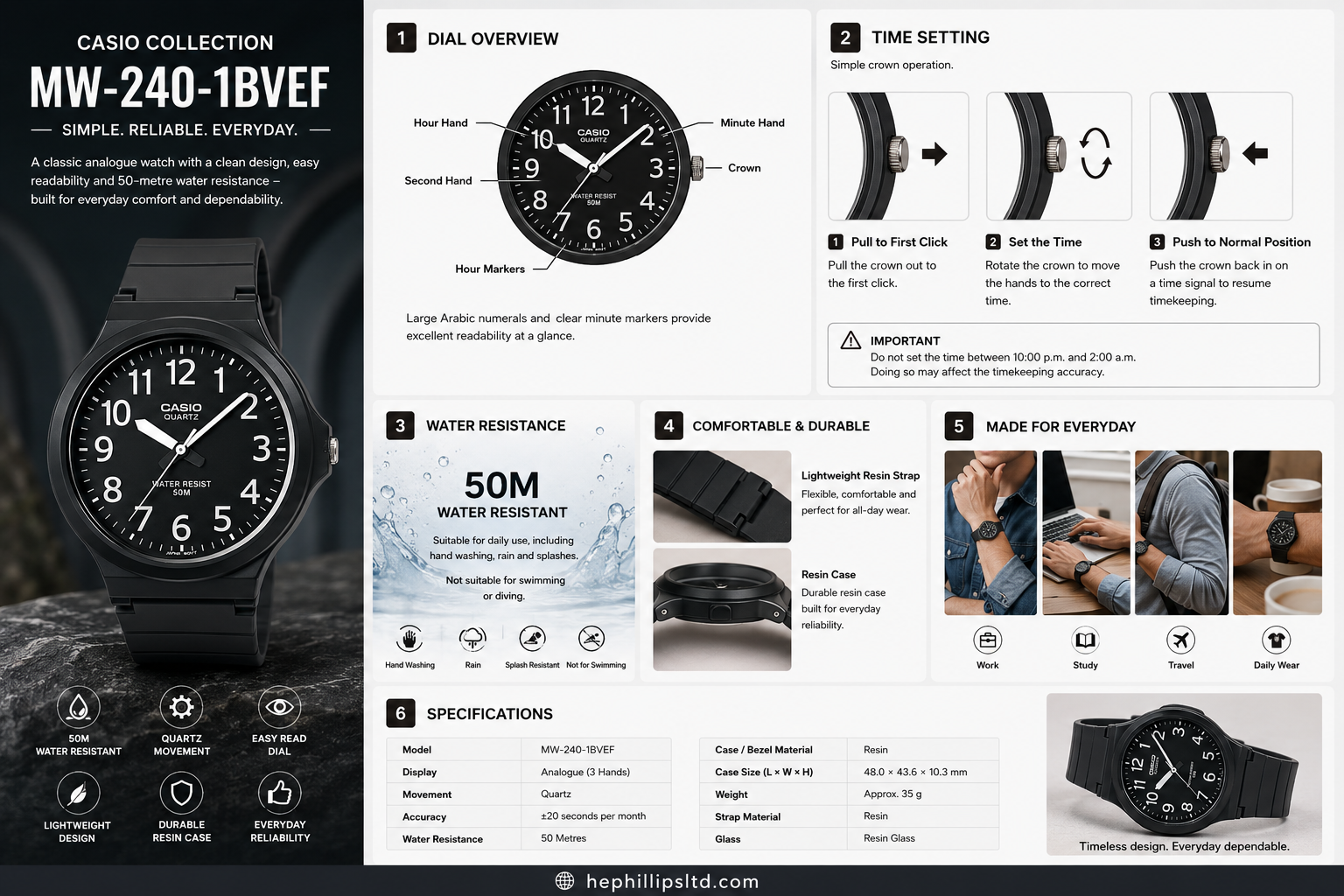
Figure 1.0: Casio MW-240-1BVEF Operation Guide.
View Official Factory Manual (PDF)
20 Technical FAQs: Engineering & Asset Management
Horological Module & Accuracy Logic
1. What is the specific quartz frequency utilized in the MW-240-1BVEF movement?
The watch utilizes an internal tuning-fork quartz crystal resonator that vibrates at exactly 32,768 Hz when an electrical current from the silver-oxide cell passes through it. This specific frequency is a horological standard because it divides down precisely to 1 Hz via an integrated circuit divider loop, which triggers a single pulse to the stepper motor every second for timing consistency.
2. How does the monthly variance of ±20 seconds manifest in daily field use?
A standard rating of plus or minus 20 seconds per month means the watch has a daily drift rate of less than 0.67 seconds under normal ambient temperatures. Unlike mechanical watches that drift by several seconds per day due to gravitational changes on the balance wheel, this quartz mechanism maintains stable timekeeping across varying user movement profiles.
3. Does the stepper motor apply continuous or discrete kinetic force to the hands?
The movement applies discrete kinetic force. The integrated circuit sends an electrical pulse to the stator of the miniature stepper motor once per second, creating a temporary magnetic field that turns the rotor by 180 degrees. This step-down motion moves the second hand in crisp, single-second increments rather than a continuous mechanical sweep, which helps conserve battery power.
4. How does the internal mounting design protect the gear train from impact shocks?
The quartz module is suspended inside a molded resin cradle that acts as a shock absorber within the main watch case. Since the entire movement assembly and gear components are constructed from lightweight plastics and metals, they have very low mass and momentum, making them inherently less susceptible to gravitational impact damage than heavy mechanical movements.
Material Science & Structural Architecture
5. What specific type of polymer resin is selected for the watch casing?
The watch case is manufactured from a formulation of acrylonitrile butadiene styrene (ABS) and polycarbonate resin blend. This specific combination provides an optimized matrix with high tensile strength, stiffness, and resistance to impacts, ensuring the exterior frame remains structurally sound under physical pressure without fracturing.
6. Why is acrylic glass used for the crystal window instead of mineral or sapphire glass?
Acrylic resin glass has a lower modulus of elasticity compared to mineral or sapphire glass, which gives it excellent flexibility and shatter resistance under direct impacts. While it is more susceptible to surface abrasions, any shallow scratches can be polished out with fine abrasive compounds, and it will not break into sharp fragments when subjected to hard mechanical drops.
7. What are the metallurgical properties of the 316L stainless steel caseback?
The caseback is stamped from 316L stainless steel, a low-carbon austenitic alloy containing chromium, nickel, and molybdenum. The addition of molybdenum significantly improves resistance to localized pitting and crevice corrosion caused by salt water or sweat, making it a reliable and hypoallergenic metal barrier against the skin.
8. How does the polyurethane resin strap respond to long-term environmental exposure?
The flexible polyurethane resin used in the strap is formulated to resist water absorption and deterioration from sweat and skin oils. However, prolonged exposure to high levels of ultraviolet (UV) radiation can slowly cross-link the polymers over several years, which may eventually lead to a loss of flexibility. Replacing the strap periodically is a normal part of maintaining the watch's ergonomics.
Environmental Sealing & Water Testing
9. What are the practical real-world limits of the 5 Bar (50m) water resistance rating?
A rating of 5 Bar means the watch case can withstand a static hydrostatic pressure equivalent to a 50-metre water column under controlled laboratory conditions. In everyday use, this protection covers rain, splashing, hand washing, and superficial surface swimming, but it does not account for dynamic pressure spikes caused by diving, diving impacts, or high-velocity water sports.
10. How does the 4-screw caseback closure manage gasket compression?
The caseback features four independent steel tensioning screws that pull the plate tightly against the primary nitrile rubber O-ring gasket. This design ensures even, uniform compression along the perimeter seal, preventing the rubber from shifting or twisting and maintaining a reliable moisture barrier over years of daily wear.
11. Why can rapid temperature changes cause internal fogging under the crystal?
If the watch is exposed to a sudden drop in temperature, such as immersion in cold water after being in the sun, the air inside the case cools rapidly. Any ambient moisture trapped inside during assembly or battery replacement can condense into fine droplets on the inner surface of the crystal. This fogging should clear once the case temperature equalizes.
12. What role do the internal crown stem gaskets play in preventing moisture ingress?
The time-setting crown stem passes through a machined channel in the resin case wall that is lined with two internal synthetic rubber O-ring seals lubricated with silicone grease. These gaskets maintain constant compression against the rotating stem to block water from passing along the shaft, whether the crown is fully pushed in or pulled out for time adjustments.
Dimensional Ergonomics & Visual Logic
13. How do the 43.6mm case dimensions balance readability with wearer comfort?
The 43.6mm width expands the dial area by over 30% compared to traditional 35mm minimalist watches, allowing for larger, highly legible numeral fonts. Despite the increased diameter, the watch maintains excellent comfort because its lightweight resin composition keeps the total mass at just 35 grams, preventing it from feeling top-heavy on the wrist.
14. What scientific principle explains the high contrast of the MW-240-1BVEF dial?
The dial utilizes a high diffuse-reflection contrast ratio. The background features a matte black coating that absorbs incoming light rays rather than reflecting them, while the solid white printed Arabic numerals scatter light uniformly across all angles, ensuring sharp character definition and rapid reading even in dim light.
15. How does the 10.3mm case thickness affect daily usability?
A case thickness of 10.3mm gives the watch a low, flat profile on the wrist. This slim dimension allows the case to slide easily underneath tight shirt cuffs or outerwear jackets without snagging, which reduces the chance of accidental impacts against door frames or equipment during manual tasks.
16. What wrist circumferences are best suited for the 48.0mm lug-to-lug height?
The 48.0mm vertical length is optimized for wrist circumferences ranging from 155mm to 210mm. Because the resin strap joints are integrated directly into the case lugs at an ergonomic downward angle, the band wraps closely around the wrist without creating wide gaps, ensuring a stable fit on both medium and large wrists.
Maintenance, Lifecycle & Benchmarks
17. What is the process for replacing the silver-oxide cell without damaging the module?
To replace the cell, the four caseback screws must be loosened in a cross pattern to prevent uneven plate tension. After removing the backplate, a non-magnetic polymer tool should be used to unclip the battery retainer spring and replace the SR626SW cell, ensuring the rubber gasket remains properly seated in its channel before reassembly.
18. How should the resin case and strap be cleaned after exposure to saltwater or sweat?
The watch should be rinsed with fresh, lukewarm water to dissolve residual salt crystals and wash away body oils that can accumulate in the strap joints. Avoid using harsh chemical detergents or solvents, which can degrade the surface finish of the matte resin; a simple wipe with a soft microfiber cloth is sufficient.
19. Can the time-setting crown mechanism be repaired or replaced if it gets damaged?
Yes. The crown and its internal stem assembly form a independent component that can be removed from the quartz module split-pin clutch. If the stem gets bent or the gaskets wear down, a watchmaker can replace the entire crown assembly to restore smooth operation and maintain the factory water resistance rating.
20. Why is this watch classified as a base-metal polymer instrument rather than a hallmarked item?
Under the UK Hallmarking Act 1973, hallmarking is strictly reserved for precious metal alloys containing minimum weight thresholds of gold, silver, platinum, or palladium. Since the MW-240-1BVEF is constructed from industrial polymers and utility-grade stainless steel, it is classified as a functional base-metal instrument and is exempt from precious metal authentication testing.
© 2026 H.E. Phillips Ltd - Official Independent Horological Analysis Hub. All Technical Data verified for structural accuracy.
Related Products
Brand New Casio Watch W-210-1C
- Brand New Casio Watch W-210-1C | Technical Analysis | H.E. Phillips Ltd ..

Limited Edition G-SHOCK DW-6900TR-1ER 30th Anniversary Black Watch - H E Phillips Ltd
- Experience three decades of unparalleled resilience and iconic design. Since its groundbreaking deb..

Casio Baby-G BG-6903 Running Series 200m Water Resistant Digital Watch
- Casio Baby-G BG-6903 Running Series 200m Water Resistant Digital Watch | Technical Analysis | H.E. P..

Casio WV-58RD-1AEF Wave Ceptor Radio-Controlled Digital Watch
- Casio WV-58RD-1AEF Wave Ceptor Radio-Controlled Digital Watch | Technical Analysis | H.E. Phillips L..

Casio G-Shock GA-B2100C-9AER Yellow Bluetooth Tough Solar CasiOak Watch
- Casio G-Shock GA-B2100C-9AER Yellow Bluetooth Tough Solar CasiOak Watch | Technical Analysis | H.E. ..

Casio Baby-G BG-169PB-2ER Pastel Blue Beach Colors 200m Water Resistant Watch
- Casio Baby-G BG-169PB-2ER Pastel Blue Beach Colors 200m Water Resistant Watch | Technical Analysis |..

Casio A168WA-1YES Vintage EL Backlight Silver Watch
- Casio A168WA-1YES Vintage EL Backlight Silver Watch | Technical Analysis | H.E. Phillips Ltd ..
Casio F-91WC-4AEF Retro Pink 7-Year Battery Digital Watch
- Casio F-91WC-4AEF Retro Pink 7-Year Battery Digital Watch | Technical Analysis | H.E. Phillips Ltd ..

Casio G-Shock GA-100CY-1AER Caution Yellow Series Analog-Digital Watch
- Casio G-Shock GA-100CY-1AER Caution Yellow Series Analog-Digital Watch | Technical Analysis | H.E. P..

Casio G-Shock DW-6900TR-4ER Burning Red Triple Graph Digital Watch
- Casio G-Shock DW-6900TR-4ER Burning Red Triple Graph Digital Watch | Technical Analysis | H.E. Phill..

Casio W-800H-1AVES 10-Year Battery 100m Water Resistant Square Digital Watch
- Casio W-800H-1AVES 10-Year Battery 100m Water Resistant Square Digital Watch | Technical Analysis | ..

Casio G-Shock GA-2300-8AER Grey Minimalist Carbon Core Guard Watch
- Casio G-Shock GA-2300-8AER Grey Minimalist Carbon Core Guard Watch | Technical Analysis | H.E. Phill..

Casio AQ-S820W-1AVEF Tough Solar Analog-Digital 100m Sport Watch
- Casio AQ-S820W-1AVEF Tough Solar Analog-Digital 100m Sport Watch | Technical Analysis | H.E. Phillip..

Casio F-91WC-4A2EF Retro Orange 7-Year Battery Digital Watch
- Casio F-91WC-4A2EF Retro Orange 7-Year Battery Digital Watch | Technical Analysis | H.E. Phillips Lt..