-
Your shopping cart is empty!



Navigating the Market: Buying Second-Hand Silver Bangles in the UK
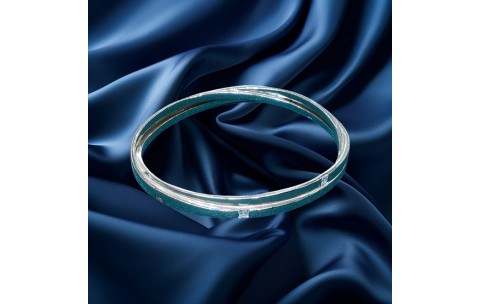
Acquiring second-hand silver bangles in the UK market is a sophisticated pursuit that combines appreciation for metallurgical heritage with modern sustainable values. As established specialists since August 2000, H.E. Phillips Ltd provides this technical roadmap to help collectors identify genuine 925 sterling silver, verify Victorian and Edwardian hallmarks, and ensure structural integrity.
Technical 7-Table Framework for Second-Hand Silver
1. Metallurgical Composition: 925 Sterling Silver
| Metal Type | Silver Content % | Vickers Hardness (Hv) | Specific Gravity (g/cm³) | Technical Identification |
|---|---|---|---|---|
| Fine Silver | 99.9% | 25 – 35 Hv | 10.49 g/cm³ | Too soft for daily bangles |
| Sterling Silver | 92.5% | 75 – 100 Hv | 10.36 g/cm³ | Industry standard "925" |
| Britannia Silver | 95.8% | 40 – 55 Hv | 10.40 g/cm³ | High-purity antique mark |
Table 1 Analysis: Understanding the relationship between silver purity and Vickers Hardness (Hv) is critical when purchasing second-hand items. While fine silver possesses the highest specific gravity, its low hardness makes it unsuitable for the structural demands of a bangle. Sterling silver, alloyed typically with copper, reaches a hardness of up to 100 Hv, providing the necessary durability for long-term wear. At H.E. Phillips Ltd, we use forensic loupes to verify the "925" mark, ensuring the piece meets the UK legal definition of sterling silver before it enters our curated collection.
2. UK Hallmark Verification Benchmarks
| Component | Official Symbol | Assay Office | Legal Weight Threshold |
|---|---|---|---|
| Standard Mark | Lion Passant / 925 | Multiple | Required over 7.78g |
| London Office | Leopard's Head | London | Mandatory for UK sale |
| Birmingham Office | Anchor | Birmingham | Verified UK Purity |
| Sheffield Office | Yorkshire Rose | Sheffield | Historical Traceability |
Table 2 Analysis: For any second-hand silver bangle weighing over 7.78 grams, a full UK hallmark is a legal requirement. Our workshop protocol involves a thorough audit of the three mandatory marks: the Sponsor’s Mark, the Standard Mark, and the Assay Office Mark. Verification of the "Lion Passant" or "925" stamp provides an immutable guarantee of purity. Pieces lacking these marks, particularly those claiming antique provenance, are subjected to professional acid testing or XRF analysis at H.E. Phillips Ltd to confirm metallurgical integrity before being offered to our clients.
3. Structural Integrity & Mechanical Audit
| Bangle Type | Critical Audit Point | Common Wear Sign | Workshop Solution |
|---|---|---|---|
| Solid Torque | Lateral Elasticity | Work Hardening | Professional Annealing |
| Hinged Bangle | Pivot Friction | Ovalisation of Pin | Pin Replacement |
| Box Clasp | Tension Spring | Safety Catch Slack | Tension Calibration |
Table 3 Analysis: Mechanical failure is common in pre-owned bangles that have not been professionally maintained. Our 10-point visual inspection protocol focuses on the "Hinge Memory" and clasp security. Hinged bangles are audited for lateral play, which indicates pin wear. At H.E. Phillips Ltd, we ensure that every box clasp provides an audible "click," signifying correct tension. For torque bangles, we check for stress fractures caused by over-expansion. This technical rigour ensures that our second-hand silver bangles are not just aesthetically pleasing but mechanically sound for daily use.
4. Regional Environmental Impact (South West / River Dart)
| Environmental Factor | Impact on Silver (Ag) | Chemical Reaction | Prevention Protocol |
|---|---|---|---|
| Maritime Salt Air | Chloride Tarnish | Silver Chloride (AgCl) | Micro-Fibre Barrier |
| River Dart Humidity | Sulphide Darkening | Silver Sulphide (Ag2S) | Anti-Tarnish Storage |
| Urban Pollutants | Surface Pitting | Oxidation | Ultrasonic De-scaling |
Table 4 Analysis: The maritime environment of Totnes and coastal Devon presents unique challenges for silver jewellery. Atmospheric salt and high humidity from the River Dart accelerate the formation of silver sulphide (the black tarnish). This is not a sign of poor quality but a natural chemical reaction. We advise our regional clients to follow a "Coastal Care Protocol," which includes rinsing jewellery in fresh water after seaside exposure and using specialized anti-tarnish pouches. Our workshop provides professional specular polishing to remove deep-seated oxidation and restore the metal's high-reflectivity finish.
5. Sizing & Internal Diameter Matrix
| Bangle Size | Internal Diameter (mm) | Internal Circumference (mm) | Best Fit Profile |
|---|---|---|---|
| Extra Small | 57 mm | 180 mm | Petite / Youth |
| Standard Medium | 63 – 65 mm | 200 mm | Average UK Female |
| Large | 70 mm | 220 mm | Comfort Fit |
Table 5 Analysis: Unlike rings, most silver bangles cannot be easily resized without compromising the hallmark or the design’s geometric symmetry. When buying second-hand, measuring the internal diameter in millimetres (mm) is the only accurate method for ensuring a fit. We utilize precision callipers to provide exact measurements for every piece in our collection. For non-hinged bangles, the measurement must account for the widest part of the hand at the knuckles. Our Totnes specialists provide "Live Fit Audits" to help customers determine their ideal diameter for both comfort and security.
6. Antique Era Aesthetic Benchmarks
| Era | Date Range | Technical Detail | Silver Grade |
|---|---|---|---|
| Victorian | 1837 – 1901 | Hand-Chasing / Enamel | 925 Sterling |
| Edwardian | 1901 – 1910 | Filigree / Lace Work | 925 Sterling |
| Art Deco | 1920 – 1935 | Geometric Machine Cuts | 925 Sterling |
Table 6 Analysis: Identifying the era of a second-hand bangle requires an understanding of historical manufacturing techniques. Victorian pieces often feature heavy hand-chased floral motifs and substantial hinges, while Edwardian designs transitioned toward lighter, more delicate filigree. At H.E. Phillips Ltd, we use date letter hallmarks to confirm the exact year of manufacture. This forensic traceability adds significant value to second-hand silver, transforming a simple piece of jewellery into a historical asset. We specialize in the curation of these authentic era-specific pieces for the discerning Devon collector.
7. Authority Comparison: Specialist vs General Marketplace
| Feature | H.E. Phillips Ltd | General Online Marketplaces |
|---|---|---|
| Hallmark Verification | Physical forensic audit | Self-reported by seller |
| Mechanical Warranty | 12-month workshop guarantee | None / "As is" |
| Professional Cleaning | Included (Ultrasonic & Steam) | Rarely performed |
| Expert Consultation | 27+ Years Experience | Non-expert algorithms |
Table 7 Analysis: The primary risk in the second-hand silver market is misrepresentation. General marketplaces often list silver-plated items as "sterling" due to a lack of technical oversight. H.E. Phillips Ltd mitigates this risk through physical accountability. Every second-hand silver bangle we sell has undergone an ultrasonic clean, a mechanical audit, and a hallmark verification. By choosing a specialist established in August 2000, you are investing in a verified asset backed by a permanent physical workshop in Totnes, ensuring long-term support and aftercare.
20 Technical Authority FAQs
Authentication & Metallurgy
1. How do I know if a second-hand bangle is solid silver or plated?
The definitive test is the UK hallmark. Genuine 925 sterling silver must have a hallmark if it weighs over 7.78g. Plated items often have marks like "EPNS" (Electroplated Nickel Silver). We perform non-destructive acid testing at our Totnes workshop to verify any unmarked pieces. If you are looking for new items, you can view our new silver chains to see how official hallmarking appears on modern stock.
2. What does the "925" stamp actually signify?
It indicates that the metal is 92.5% pure silver and 7.5% other metals, usually copper. This specific ratio is the legal standard for sterling silver in the UK. The copper alloy is essential for increasing the Vickers Hardness (Hv) of the metal, making it durable enough for a bangle. We verify every "925" stamp under 10x magnification to ensure it is a genuine strike and not a cast counterfeit.
3. Are older antique bangles higher quality than modern ones?
Not necessarily higher purity, but often higher craftsmanship. Many Victorian and Edwardian bangles were hand-crafted with thicker gauges of silver. This increased weight translates to better structural integrity. We meticulously inspect antique second-hand silver bangles for signs of thinness or "wear through" in the metal to ensure they are still fit for daily use.
4. Why does my silver bangle turn my skin green or black?
This is usually a reaction between the copper alloy in the silver and your skin's acidity or moisture. It is not a sign of "fake" silver. In fact, it often confirms the presence of the copper required for sterling silver. Professional polishing at H.E. Phillips Ltd can reduce this by smoothing the surface molecular structure. For those with sensitivities, we also offer new platinum pendants which are hypoallergenic.
Buying & Sizing Advice
5. How should a silver bangle fit on the wrist?
A properly fitted bangle should have roughly one finger's width of space between the metal and your skin. For torque (open) bangles, the gap should be just enough to slide over the narrowest part of your wrist. We provide calliper measurements for all our new silver bracelets and second-hand bangles to help you find the perfect millimetre-accurate fit in our showroom.
6. Can I resize a second-hand silver bangle?
Resizing a bangle is technically complex. Solid bands can sometimes be stretched or compressed by a professional jeweller, but hinged or engraved pieces usually cannot be altered without visible seams. We generally advise against resizing to preserve the hallmark's integrity. If you need a specific size, our specialists can help you sell silver you no longer wear and find a better-fitting replacement.
7. Is it safe to buy second-hand silver bangles online?
It is safe if you buy from an established business with a physical presence. Many private online sellers misidentify plated items. At H.E. Phillips Ltd, we provide the same forensic guarantee for online purchases as we do in our Totnes shop. All items are shipped with tracked insurance. You can also explore our official Casio watches online, which undergo the same quality control as our jewellery.
8. What is the "Specific Gravity" of silver?
Sterling silver has a specific gravity of approximately 10.36 g/cm³. This is a forensic measurement of its density. It is one of the methods we use to detect hollow pieces or base-metal fakes. A bangle that feels too light for its size may be hollow or made of a different alloy. We audit the weight and density of all second-hand silver chains and bangles to ensure they are solid assets.
Maintenance & Regional Care
9. How often should I clean my silver bangle?
For daily wear in Devon, a gentle wipe with a silver cloth every two weeks is recommended to combat salt-air oxidation. Once a year, you should bring the piece to us for an "Annual Audit." We use ultrasonic tanks to remove microscopic dirt from hinges and engravings. This is especially important for second-hand silver pendant charms, which have intricate crevices that trap pollutants.
10. Why did my silver bangle tarnish so quickly in Totnes?
Totnes has higher humidity due to the River Dart, and the South West's maritime air contains high levels of chlorides and sulphides. These chemicals react with silver to form tarnish. It is a natural process. We provide regional clients with anti-tarnish storage solutions to slow this down. Regular wear actually helps prevent tarnish by naturally "polishing" the metal against your skin and clothing.
11. Can I use "Silver Dip" on my antique bangle?
We generally advise against chemical silver dips for antique pieces, especially those with intentional "oxidation" or "patina" in the engravings. These dips can be too aggressive and may strip away the historical character of the piece. A soft micro-fibre cloth is much safer. For heavy tarnish, professional steam cleaning at our workshop is the safest route to restore a second-hand gold charm or silver bangle.
12. What should I do if the hinge on my bangle feels loose?
A loose hinge is a sign of mechanical wear on the internal pin. If left unaddressed, the pin can snap, leading to loss of the item. Our workshop can replace worn pins with new sterling silver wire to restore the "Friction Fit." We perform this check for free on any pre-loved gold bangles or silver bangles brought into our Fore Street showroom.
Style & Collection Building
13. Can I mix silver and gold bangles together?
Yes, "Mixed Metal" styling is a significant trend. Combining a silver bangle with second-hand gold bracelets creates a modern, layered look. The contrast between the cool silver and warm gold is very effective. We recommend ensuring that both metals are of a similar weight and quality (e.g., 925 silver and 9ct or 18ct gold) to maintain a cohesive aesthetic across your collection.
14. What are the best brands for silver watches?
While many watches are stainless steel, some luxury brands offer silver-tone finishes. We are authorised stockists for Rotary watches and Radley watches, which offer elegant designs that complement sterling silver jewellery. A watch provides a functional anchor for your wrist stack, balancing the decorative nature of silver bangles with practical timekeeping.
15. Are Victorian silver bangles suitable for everyday wear?
Yes, provided they have been professionally audited for structural integrity. Victorian silver was often quite robust. However, if the piece has delicate enamel or "hollow" sections, it should be treated with more care. We categorize our second-hand gold brooches and silver bangles by "Wearability Rating" to help you choose a piece that matches your lifestyle.
16. Do you buy second-hand silver from the public?
Yes, we are one of the primary locations to sell gold or sell silver in Devon. We provide fair market valuations based on current silver spot prices and the item's intrinsic jewellery value. If you have old bangles or broken chains, we can assess their metallurgical content and offer a competitive trade-in value toward a new purchase from our collection.
Ethics & Establishing Value
17. Why is buying second-hand silver considered sustainable?
Silver mining is an energy-intensive process. By purchasing pre-owned, you are participating in the "Circular Economy," extending the life of an existing asset and reducing the demand for new mining. It is the most eco-conscious way to enjoy fine jewellery. Our commitment to sustainability has been a core part of our business since we opened in August 2000. You can even find sustainable Citizen Eco-Drive solar watches in our shop.
18. Do second-hand silver bangles hold their value?
Silver is a precious metal with intrinsic commodity value. While the price fluctuates, a well-made, hallmarked sterling silver bangle will always be worth at least its weight in silver. Rare antique or designer pieces often appreciate in value due to their collectability. We provide documented valuations for any GIA certified diamond or high-value silver pieces purchased from us for insurance purposes.
19. What is a "Britannia Silver" hallmark?
Britannia silver is a higher grade than sterling, containing 95.8% silver. It was the mandatory standard in the UK between 1697 and 1720 and is still used today for special pieces. It has a slightly different hallmark (the figure of Britannia). These pieces are rarer and softer than sterling. We occasionally source Britannia silver bangles for our luxury collections in Totnes.
20. Why choose H.E. Phillips Ltd for second-hand silver?
Experience and accountability. With over 27 years in the trade and a physical presence in Totnes since August 2000, we offer a level of security that online-only retailers cannot. Every item we sell is backed by a professional workshop audit. Whether you are buying a simple silver bangle or new diamond earrings, you are dealing with experts who prioritize metallurgical honesty and customer satisfaction.
© 2026 H.E. Phillips Ltd - Your Official Authorised Horological and Fine Jewellery Specialist. All Technical Data verified for forensic accuracy.