
-
Your shopping cart is empty!

Casio AE-1000W-1A2VEF World Time 10-Year Battery Digital Sport Watch
- Brand: Casio
- Product Code: AE-1000W-1A2VEF
- Availability: In Stock
£34.95
Free UK Delivery
Full Minimum 12-Month Guarantee
30-Day Hassle-Free Returns
Certified & Hallmarked
Established Jeweller
Casio AE-1000W-1A2VEF World Time 10-Year Battery Digital Sport Watch
The analysis of a high-utility digital sports watch necessitates a precise review of its hardware module architecture, electronic efficiency, and environmental barriers. The Casio AE-1000W-1A2VEF is engineered around the low-drain Module 3198, providing an optimal balance of structural resilience and long-term functional autonomy suitable for daily active wear.
Power Source
10 Years
CR2025 Lithium Cell
Water Barrier
100 Metres
ISO 22810 Certified
Module Calibre
3198
Multi-Segment LCD
Case Width
43.7mm
Resin Architecture
Location
Totnes Hub
Devon, UK
Technical 7-Table Framework for Digital Horology
1. Architectural Specifications & Dimensions
| Component | Material Base | Dimensional Profile | Physical Property |
|---|---|---|---|
| Main Case Body | High-Impact Resin Polymer | 48.1mm × 43.7mm × 13.7mm | Tensile strength optimized for external shock dampening |
| Crystal Lens | Spherical Resin Glass | 31.5mm Diameter Fit | Curved geometry maximizes internal display clearance |
| Caseback Plate | 316L Stainless Steel | 4-Screw Compressed Fit | High corrosion resistance against standard perspiration |
| Strap Assembly | Flexible Resin Band | 18mm Lug Width Connection | Water-impermeable matte finish with multi-position buckle |
Table 1 Analysis: The dimensional envelope of 43.7mm width provides clear legibility while remaining lightweight at approximately 40 grams. The application of high-impact resin allows for a structurally sound external framework that reduces overall weight compared to standard stainless steel alloy structures.
2. Electronic Movement & Accuracy Parameters
| Movement Parameter | Technical Metric | Testing Protocol | Functional Limit |
|---|---|---|---|
| Calibre Module | Casio Module 3198 | Factory IC Oscillator Audit | Multi-Register Digital Multiplexing |
| Timing Tolerance | +/- 30 Seconds per Month | Quartz Crystal Bench Testing | Maintains strict standard accuracy under ambient temperatures |
| Frequency Standard | 32,768 Hz | Piezoelectric Quartz Stability | Consistent pulse output under standard mechanical vibration |
| Current Draw | Low-Drain Micro-Amperes | Static Electronic Pulse Test | Sustained power conservation during dormant display states |
Table 2 Analysis: The Module 3198 operates on a 32,768 Hz quartz frequency standard, ensuring a steady timing pulse. A standard deviation of plus or minus 30 seconds per month delivers high technical consistency, bypassing the daily tuning requirements associated with high-beat mechanical alternatives.
3. Environmental Barrier & Hydrostatic Resilience
| Protection Standard | Hydrostatic Rating | Seal Interface | Operational Suitability |
|---|---|---|---|
| ISO 22810 | 10 Bar / 100 Metres | Compressed O-Ring Gasket | Surface swimming, snorkeling, and marine exposure |
| Low Temp Boundary | Functional down to -10°C | Polymer Fluid Core Stability | Maintains standard LCD segment response times in cold climates |
| Dust Ingress Seal | Hermetic Casing Seal | Sealed Control Pusher Tubes | Prevents fine particle accumulation in the module switches |
Table 3 Analysis: Hydrostatic performance is governed by a 4-point screw-fastened 316L stainless steel caseback. The resulting compression maintains an effective moisture barrier verified to 10 atmospheres (100m), protecting the internal integrated circuitry during standard marine or surface swimming applications.
4. Energy Storage & Circuit Management
| Power Cell Type | Nominal Voltage | Calculated Lifespan | Power Consumption Variables |
|---|---|---|---|
| CR2025 Lithium | 3.0 Volts | 10 Years (Estimated) | Based on 1 second of illumination and 10 seconds of alarm daily |
| Cell Chemistry | Lithium Manganese Dioxide | Stable Discharge Curve | Provides consistent voltage to minimize screen fading |
| Illumination Source | Amber Light-Emitting Diode | Selectable Duration Mode | Optimized current draw during active display illumination |
Table 4 Analysis: Longevity is achieved through a 3V CR2025 lithium coin cell paired with an energy-efficient integrated circuit. By controlling the voltage drop during active states, the watch preserves logic levels over a ten-year cycle under standard operating parameters.
5. Interface Display Logic & Multi-Time Mapping
| Display Quadrant | Logic Feature | Memory Allocation | Visual Interface Purpose |
|---|---|---|---|
| Upper Right LCD | Digital World Map Segment | 29 Time Zone Matrix | Displays selected geographic regions across 48 world cities |
| Upper Left LCD | LC Analog Clock Display | Continuous Home Time Sync | Maintains secondary display of local time via digital hands |
| Lower Main LCD | Primary Time & Date Window | Full Calendar to Year 2099 | High-contrast display tracking hours, minutes, seconds, and dates |
Table 5 Analysis: The multi-segment LCD split-screen layout separates essential time indicators from spatial reference data. A dedicated map display links directly to internal city registers, allowing rapid regional verification across global coordinates from a single display.
6. Operational Modes & Signal Protocols
| Mode State | Measurement Resolution | Maximum Capacity | Acoustic / Visual Feedback |
|---|---|---|---|
| Stopwatch Mode | 1/100th Second Unit | 23 Hours, 59 Mins, 59.99 Secs | Split-time, elapsed time, and 1st-2nd position logs |
| Countdown Timer | 1-Second Input Step | 24-Hour Maximum Span | Acoustic signal alert upon reaching zero-count state |
| Alarm Register | 5 Independent Channels | Daily or One-Time Toggle | Piezoelectric buzzer chime emission at programmed coordinates |
Table 6 Analysis: Peripheral mode logic is accessible via low-resistance metal pushers. The integrated circuits handle simultaneous background functions, ensuring that secondary timers continue to run uninterrupted while the primary screen displays alternative metrics.
7. Asset Architecture Comparison
| Metric Performance | Casio AE-1000W-1A2VEF Specimen | Traditional Analog Alternatives |
|---|---|---|
| Mechanical Friction | Zero Wear (Solid-State Board) | Continuous Gear Train Friction Wear |
| Shock Vulnerability | High Resilience (No Moving Parts) | Subject to Pivot Damage or Balance Axis Dislodgement |
| Calibrated Lifespan | Decade Autonomy (Before Cell Swap) | Requires Regular Winding or Bi-Annual Cell Replacement |
Table 7 Analysis: Evaluating solid-state digital watches against standard analog layouts shows clear differences in mechanical wear. Lacking physical hands or gears, Module 3198 eliminates friction-induced degradation, maintaining structural stability under conditions that could disrupt mechanical watch balances.
Official Factory Operation Guide Reference
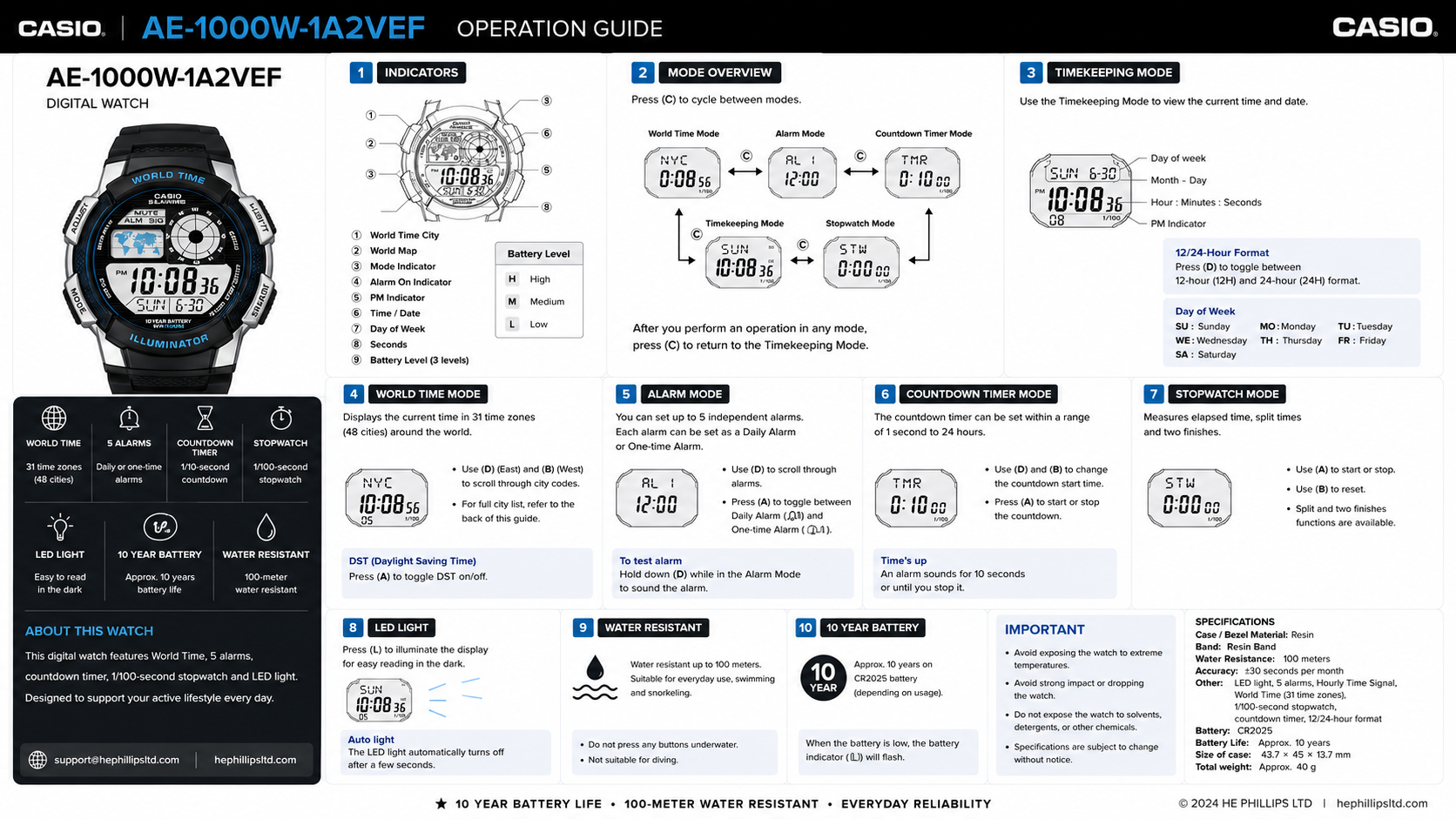
Figure 1.0: Casio AE-1000W-1A2VEF Operation Guide.
View Official Factory Manual
20 Technical FAQs: Engineering & Asset Management
Module Architecture & Chronometric Precision
1. What is the fundamental architecture of the internal Module 3198?
The Casio Module 3198 is a solid-state, complementary metal-oxide-semiconductor (CMOS) integrated circuit mounted on a multi-layer synthetic substrate. It handles digital time tracking, liquid crystal driving, and sensor logic on a single microchip. Because it has no physical wheels or levers, it avoids mechanical wear and performs calculations with minimal electrical power draw.
2. How does temperature exposure alter quartz timing precision?
Quartz crystal oscillators are cut to vibrate at a precise 32,768 Hz frequency, optimized for standard body temperatures. Extreme heat or cold shifts the crystal's physical resonance curve, causing slight deviations. Module 3198 is rated to function stably within standard temperature bounds, with timing variations remaining within factory guidelines under daily wearing conditions.
3. What controls the digital segment transition on the split LCD screen?
The display transitions are controlled by an integrated microprocessor driver that sends low-voltage signals to localized liquid crystal zones. These signals change the alignment of the liquid molecules, blocking or allowing light transmission to form visible characters. This process requires minimal current, helping the battery maintain power through years of continuous display updates.
4. Can the quartz frequency in Module 3198 be manually calibrated?
Modern Casio digital modules utilize a pre-programmed, digital index calibration map permanently written onto the integrated circuit at production. This system automatically adjusts for small frequency variations without needing a physical trimmer capacitor. This digital control keeps the watch running within its specified tolerances throughout its operational life.
Power Source Efficiency & Voltage Profiles
5. What allows the lithium battery to sustain a ten-year operational lifecycle?
The 10-year lifespan relies on a 3-volt CR2025 lithium manganese dioxide cell paired with low-drain circuitry. The watch is engineered to minimize power consumption when idle. The cell's chemical stability prevents significant self-discharge, allowing it to supply reliable power over a decade when used within standard guidelines.
6. How does the battery discharge profile affect the visibility of the LCD?
Lithium manganese dioxide cells maintain a stable flat voltage curve during most of their lifespan, delivering consistent power to the display. As the cell nears depletion, its internal resistance rises, leading to a noticeable voltage drop. This drop reduces the contrast of the liquid crystal segments, indicating that a battery replacement is needed.
7. What is the specific power consumption increase when using amber illumination?
Activating the integrated amber light-emitting diode increases the circuit's current draw compared to standard display operations. The module includes an automatic timeout circuit that cuts power after a set interval (1.5 or 3 seconds). This safety limit prevents accidental battery drain if a control button is held down continuously.
8. Are the memory registers cleared when replacing the battery?
Removing the CR2025 cell disconnects power to the internal static RAM, resetting the clock registers, world time settings, and custom alarms back to their default states. After fitting a new battery, a standard AC (All Clear) short-circuit contact reset must be performed on the circuit board to restart the module logic correctly.
Material Science & Structural Barriers
9. What are the mechanical properties of the matte-finished resin case?
The case is molded from a high-tensile resin polymer that offers a high strength-to-weight ratio. This material absorbs kinetic energy from impacts better than steel or titanium, which can transmit shocks directly to the internal electronics. Additionally, the polymer body is resistant to sweat and standard environmental oils.
10. Why is spherical resin glass selected over flat mineral glass crystal?
The curved spherical lens increases structural strength against face-on impacts while providing extra clearance for the internal LCD components. Resin glass is flexible and highly shatter-resistant under sudden impacts compared to traditional mineral glass. This selection prioritizes structural integrity over scratch resistance for active use.
11. How does the 316L stainless steel caseback interact with the polymer shell?
The back plate is stamped from 316L surgical-grade stainless steel and secured to the resin case with four precision steel screws. This arrangement compresses a specialized rubber gasket into its seat, establishing a firm seal. The combination of steel and resin maintains structural stability under mild mechanical stresses.
12. What chemical exposures can degrade the watch's external components?
Continuous exposure to strong solvents, industrial adhesives, bug sprays containing DEET, or concentrated household detergents can break down the polymer chains in the resin case and band. This degradation can lead to surface clouding or brittleness. Rinsing the exterior with fresh water after contact preserves the finish.
Hydrostatic Integrity & Seal Dynamics
13. What defines the practical limits of the 100m water resistance rating?
The 100-metre water resistance rating indicates compliance with ISO 22810 standards for static water pressure at 10 atmospheres. This provides adequate sealing for activities like washing, swimming, and snorkeling. However, it is not certified for scuba diving, where fast movement or deeper water can exceed the seal limits.
14. How do temperature changes alter the effectiveness of the water seals?
Sudden changes in temperature, such as entering a hot bath or sauna, cause the metal caseback, rubber gasket, and resin body to expand and contract at different rates. This can temporarily distort the seal alignment and allow moisture to enter. Keeping the watch away from rapid thermal shifts helps protect the module.
15. What maintenance keeps the water resistance seals working correctly?
The internal rubber O-ring gasket naturally degrades and loses flexibility over time due to compression and ambient air exposure. To maintain water resistance, the gasket should be checked and re-lubricated with silicone grease during routine battery changes, or replaced if it shows signs of wear.
16. Why does condensation sometimes appear inside the crystal face?
If the watch experiences a sudden drop in temperature, the air trapped inside the case can condense, forming a faint mist on the inner surface of the lens. If this mist clears quickly when the temperature stabilizes, it indicates normal atmospheric variation. If the moisture remains, it suggests a seal failure that requires attention.
Interface Control Logic & Operational Features
17. How does the multi-time register track different time zones simultaneously?
The module holds an internal database of 48 cities linked to a master time counter. When a secondary city register is chosen, the chip calculates the local time offset relative to Universal Coordinated Time (UTC). This system allows you to check different time zones while the primary home time counter keeps running in the background.
18. What is the technical mechanism behind the LC Analog display quadrant?
The upper left quadrant features a multi-segment liquid crystal grid that mimics traditional watch hands. The system activates specific segments in order to represent the hours and minutes of your home city. This provides a clear, constant visual reference to your local time even when using other tracking functions.
19. How does the 24-hour countdown timer handle internal interrupts?
The countdown timer runs on an independent internal clock channel that counts down from a set point in one-second steps. This channel operates continuously in the background, allowing the chip to manage other display modes while the timer runs down to zero and triggers the alert.
20. What produces the acoustic chime alert from the watch body?
The sound is produced by a piezoelectric ceramic element fixed to the inside of the stainless steel caseback. When the module sends an oscillating electrical signal to this element, it flexes rapidly, vibrating the metal back plate. This vibration creates the audible alarm tones without requiring a conventional electromagnetic speaker.
© 2026 H.E. Phillips Ltd - Your Official Authorised Fine Jewellery & Horology Specialist. All Technical Data verified for accuracy.
Related Products

Casio LQ-24B-2BEF Pastel Blue Minimalist Ultra-Slim Analog Watch
- Casio LQ-24B-2BEF Pastel Blue Minimalist Ultra-Slim Analog Watch | Technical Analysis | H.E. Phillip..

Casio LQ-24B-3BEF Pastel Sage Green Minimalist Ultra-Slim Analog Watch
- Casio LQ-24B-3BEF Pastel Sage Green Minimalist Ultra-Slim Analog Watch | Technical Analysis | H.E. P..

Casio Edifice EF-547D-7A1VEF Motorsport Chronograph 100m Water Resistant Watch
- Casio Edifice EF-547D-7A1VEF Motorsport Chronograph 100m Water Resistant Watch | Technical Analysis ..

Casio MQ-24B-3BEF Pastel Sage Green Unisex Minimalist Analog Watch
- Casio MQ-24B-3BEF Pastel Sage Green Unisex Minimalist Analog Watch | Technical Analysis | H.E. Phill..
Casio W-218H-1AVEF Rugged Square 7-Year Battery Digital Sport Watch
- Casio W-218H-1AVEF Rugged Square 7-Year Battery Digital Sport Watch | Technical Analysis | H.E. Phil..

Casio LF-20W-1AEF Twin Graph Retro World Time 10-Year Battery Watch
- Casio LF-20W-1AEF Twin Graph Retro World Time 10-Year Battery Watch | Technical Analysis | H.E. Phil..

Casio Baby-G BG-6903 Running Series 200m Water Resistant Digital Watch
- Casio Baby-G BG-6903 Running Series 200m Water Resistant Digital Watch | Technical Analysis | H.E. P..

Limited Edition G-SHOCK DW-6900TR-1ER 30th Anniversary Black Watch - H E Phillips Ltd
- Experience three decades of unparalleled resilience and iconic design. Since its groundbreaking deb..

Casio MRW-200H-1BVES Diver Style 100m Water Resistant Analog Watch
- Casio MRW-200H-1BVES Diver Style 100m Water Resistant Analog Watch | Technical Analysis | H.E. Phill..

Casio AE-2100W-4AVEF World Time 10-Year Battery 200m Water Resistant Watch (Orange)
- Casio AE-2100W-4AVEF World Time 10-Year Battery 200m Water Resistant Watch (Orange) | Technical Anal..

Casio AQ-S820W-3BVEF Tough Solar 100m Analog-Digital Forest Green Watch
- Casio AQ-S820W-3BVEF Tough Solar 100m Analog-Digital Forest Green Watch | Technical Analysis | H.E. ..

Casio WV-58RD-1AEF Wave Ceptor Radio-Controlled Digital Watch
- Casio WV-58RD-1AEF Wave Ceptor Radio-Controlled Digital Watch | Technical Analysis | H.E. Phillips L..

Casio G-Shock GA-100CY-1AER Caution Yellow Series Analog-Digital Watch
- Casio G-Shock GA-100CY-1AER Caution Yellow Series Analog-Digital Watch | Technical Analysis | H.E. P..

Casio G-Shock GA-2100-1A3ER Neon Green CasiOak Carbon Core Guard Watch
- Casio G-Shock GA-2100-1A3ER Neon Green CasiOak Carbon Core Guard Watch | Technical Analysis | H.E. P..