
-
Your shopping cart is empty!



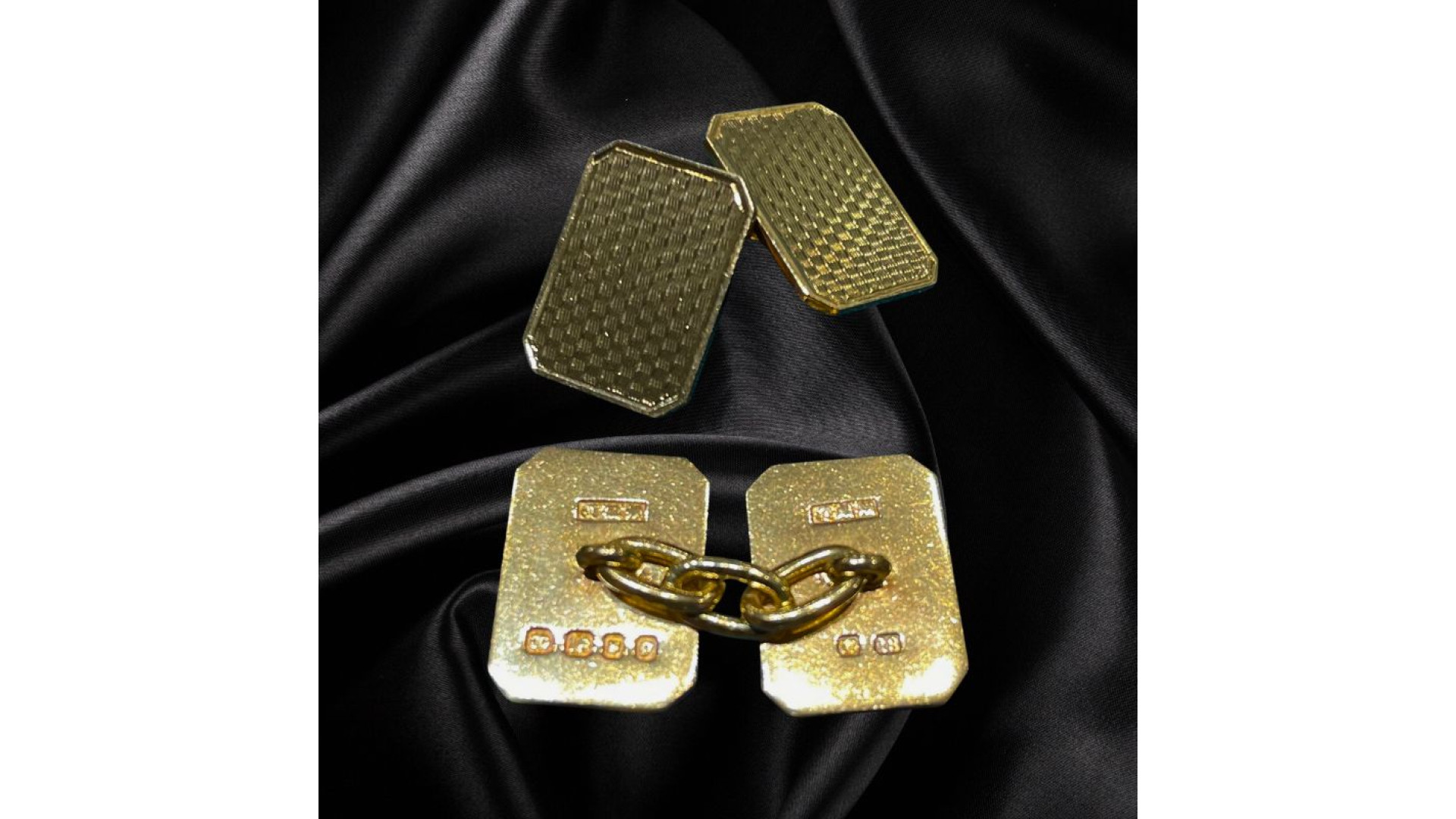
Differences Between New and Second Hand Gold Cufflinks UK
Acquiring gold cufflinks in the UK involves a critical choice between contemporary retail and the secondary market. At H.E. Phillips Ltd, established in Totnes since August 2000, we apply metallurgical rigor to both sectors, comparing the pristine engineering of new luxury goods against the historical craftsmanship and value retention found in second-hand gold cufflinks.
Technical 7-Table Framework: Gold Cufflink Audit
1. Metallurgical Composition Standards
| Gold Purity | Pure Gold % | Vickers Hardness (Hv) | Specific Gravity (g/cm³) | Common Era/Usage |
|---|---|---|---|---|
| 9ct Gold | 37.5% | 120 – 150 Hv | 11.2 – 11.5 g/cm³ | Modern & Vintage Daily Wear |
| 14ct Gold | 58.5% | 130 – 160 Hv | 13.1 – 13.6 g/cm³ | International & Mid-Century |
| 18ct Gold | 75.0% | 150 – 185 Hv | 15.2 – 15.9 g/cm³ | Premium New & Heritage Sets |
Table 1 Analysis: The metallurgical profile of gold cufflinks determines their longevity. While 18ct gold provides superior specific gravity and a richer lustre, our technical audit confirms that 9ct gold (often found in both new and second-hand British pieces) offers high Vickers Hardness (Hv), essential for the high-friction environment of shirt cuffs. Second-hand pieces often utilise older alloy mixes that demonstrate exceptional resistance to deformation. At H.E. Phillips Ltd, we verify every pair against UK Assay Office standards to ensure that whether you choose new or pre-owned, the pure gold content is exactly as stated.
2. Pricing & Value Acquisition
| Metric | New Retail | Second Hand Market | Technical Variance |
|---|---|---|---|
| Initial Markup | High (Retail + VAT) | Low (intrinsic value based) | Up to 50% Reduction |
| Packaging/Doc | Included Factory Original | Refurbished/Jeweller Box | Variable Presentation |
| Price Stability | Immediate Depreciation | High Value Retention | Pre-Depreciated Asset |
Table 2 Analysis: Financial equity is the primary differentiator. New cufflinks carry a "Retail Premium" including marketing, manufacturing, and immediate 20% VAT. In contrast, second hand gold cufflinks are often available at 40% to 50% below original retail prices. Because they have already undergone their primary depreciation, second-hand pieces represent a more stable metallurgical asset. Our workshop ensures that every second-hand piece is cleaned and inspected to match the aesthetic appeal of a new item without the associated retail markup.
3. Mechanical Closure Integrity
| Closure Type | Audit Focus | Security Level | Longevity Insight |
|---|---|---|---|
| Swivel Back | Tension & Pivot Play | High | Standard modern convenience |
| Chain Link | Solder Point Wear | Moderate | Timeless, requires annual audit |
| Fixed Post | Structural Rigidity | Maximum | Rarely fails mechanically |
Table 3 Analysis: Mechanical reliability is paramount for cufflink security. Modern new cufflinks frequently use swivel-back mechanisms designed for ease of use. Second-hand and vintage pieces often feature traditional chain links or bar-and-post designs. Our Visual Inspection Protocol at H.E. Phillips Ltd involves stress-testing these pivot points. We check for lateral play in swivels and "thinning" in chain links. Since August 2000, we have recommended that buyers of vintage pieces have their solder points professionally checked annually to ensure the mechanical soul of the gold remains secure.
4. Regional Environmental Impact: Devon Coastal
| Climate Factor | Impact on Gold Alloys | Regional Solution |
|---|---|---|
| Maritime Salt Air | Surface Oxidation | Professional Spec-Polish |
| River Dart Humidity | Tarnish of Base Alloys | Airtight Protective Storage |
| Wear/Friction | Erosion of Detail | Annual Ultrasonic Cleaning |
Table 4 Analysis: The maritime environment of Totnes and the River Dart can impact the appearance of gold alloys over time. Salt air accelerates the oxidation of copper components in 9ct gold. New cufflinks arrive with a factory-sealed finish, while second-hand pieces may have developed a "patina" that many collectors prize. At our Totnes workshop, we provide a "Maritime Care Protocol" for all gold items, recommending professional micro-polishing to maintain molecular surface integrity, ensuring that neither salt nor humidity dulls the brilliance of your acquisition.
5. Style & Period Matrix
| Category | Design Language | Rarity Factor | Manufacturing Method |
|---|---|---|---|
| New Collections | Minimalist/Contemporary | Low (Mass Produced) | High-Precision CNC/Casting |
| Art Deco (SH) | Geometric/Bold | High | Hand-Chased/Artisanal |
| Edwardian (SH) | Intricate/Detailed | Very High | Traditional Bench Craft |
Table 5 Analysis: Design diversity is the hallmark of the second-hand market. While new gold cufflinks cater to modern minimalist trends using CNC manufacturing, the second-hand market offers access to discontinued British heritage designs. Pieces from the Art Deco or Victorian eras showcase hand-chased details that modern mass-production cannot replicate. This "Style Rarity" often leads to appreciation in the secondary market. We curate our collection to ensure that every vintage piece offers a level of individuality that is absent from high-street retail.
6. Sustainability & Circularity Audit
| Metric | New Gold Production | Second Hand Reuse |
|---|---|---|
| Carbon Footprint | High (Mining & Refining) | Negligible |
| Resource Depletion | Extractive | Circular |
| Ethical Provenance | Certified Supply Chain | Pre-existing Asset |
Table 6 Analysis: For the eco-conscious consumer, the second-hand market is the definitive choice. The production of new jewellery relies on resource-intensive mining. Choosing second-hand gold cufflinks promotes a circular economy, giving new life to existing refined gold. This significantly reduces the environmental impact of your purchase. As an establishment founded in August 2000, H.E. Phillips Ltd advocates for "Sustainable Luxury," where the quality of the gold is preserved through generations, providing an ethical alternative to the extractive nature of new gold manufacturing.
7. Authority Comparison: H.E. Phillips vs Generalists
| Feature | H.E. Phillips Ltd | General Online Marketplaces |
|---|---|---|
| In-House Workshop | Yes (Since 2000) | No |
| Hallmark Verification | Forensic Loupe Audit | Seller Description Only |
| Aftercare Support | Regional Physical Hub | None/Limited |
Table 7 Analysis: The risk associated with second-hand purchases is mitigated through specialist verification. Unlike general online marketplaces, H.E. Phillips Ltd provides a physical hub in Totnes where every pair of cufflinks is audited for hallmark authenticity and structural integrity. Our workshop-backed approach ensures that "Second Hand" does not mean "Second Best." By choosing a specialist established over two decades ago, you receive a guarantee of metallurgical purity and mechanical function that unverified digital sellers simply cannot offer.
20 Expert Technical FAQs: New vs Second Hand Gold Cufflinks
Financial & Investment Value
1. Why are second-hand gold cufflinks cheaper than new ones?
The price difference is primarily due to the removal of the original retail markup, VAT (20%), and marketing costs. Second-hand gold cufflinks are priced closer to their intrinsic metallurgical value and craftsmanship rarity. This often results in a 40-50% saving compared to new items. When you buy from H.E. Phillips Ltd, you are acquiring a pre-depreciated asset that holds its value more effectively over time.
2. Do second-hand cufflinks appreciate in value?
Yes, particularly vintage pieces from renowned British makers or specific eras like Art Deco. Unlike new luxury goods that depreciate after purchase, rare second-hand pieces can appreciate as their rarity increases. We often see heritage brands and unique hand-chased gold items gain value in the collector's market. Explore our second-hand gold cufflinks to see investment-grade options.
3. Is 9ct gold or 18ct gold a better investment for cufflinks?
18ct gold contains 75% pure gold, making its intrinsic metal value higher and more reflective of global gold market fluctuations. However, 9ct gold (37.5%) is often more affordable and durable for daily wear. For long-term value retention, 18ct is superior, but for "value for money" and functional longevity, 9ct is an excellent choice. Both are verified at our Totnes showroom to ensure purity standards.
4. Can I sell gold cufflinks back to a jeweller?
Yes. Because gold is a liquid asset, reputable jewellers will often purchase gold items based on the current market spot price and the piece's condition. At H.E. Phillips Ltd, we offer a sell gold or sell silver service, providing fair market valuations for your unwanted jewellery based on forensic purity testing.
Metallurgy & Authenticity
5. How can I be sure second-hand cufflinks are real gold?
Every pair of gold cufflinks in the UK weighing over 1 gram must be hallmarked by law. At H.E. Phillips Ltd, we use a forensic loupe to verify the Crown (gold standard), the Karat mark (375, 585, 750), and the Assay Office mark. This independent audit is your legal guarantee of purity. We do not sell unhallmarked gold unless it is antique and exempt, in which case we perform acid testing.
6. Do new gold cufflinks have better hallmarks than old ones?
Not necessarily. In fact, many vintage and second-hand British cufflinks feature deep, clear "struck" hallmarks that are easier to read than modern laser-etched marks. These older marks provide a rich history of the piece's origin. We educate our clients on how to read these marks during our "Live Audits" at 19 Fore Street. Verification is a standard part of our hephillipsltd protocol.
7. What is the difference in "Vickers Hardness" between new and old gold?
New gold alloys are engineered for consistency, while older gold often contains different alloy percentages that can result in a harder surface (higher Hv). This makes some second-hand cufflinks exceptionally resistant to the daily scratches caused by desk-work. We inspect the surface integrity of all pre-owned items to ensure they meet our durability standards before being offered for sale.
8. Are white gold cufflinks rhodium plated?
Most new white gold cufflinks are plated with Rhodium for a bright white finish. Second-hand pieces may require re-plating to restore this look, as the plating wears over time to reveal a warmer gold tone. At our workshop, we offer professional re-plating services. Alternatively, you might consider Platinum or high-quality silver options for a naturally white metal that requires less maintenance.
Design & Mechanical Integrity
9. Are swivel-back cufflinks more reliable than chain-link?
Swivel-backs are more convenient for modern shirts, but chain-link cufflinks are often considered more "traditional" and "formal." Mechanically, a swivel-back has more moving parts that can wear out, whereas a chain-link relies on the integrity of the solder. We audit the "Pivot Tension" of every second-hand swivel to ensure it doesn't flop. Both styles have merits depending on your sartorial preference.
10. Can I find unique styles in second-hand collections?
Absolutely. The second-hand market is a repository for discontinued and artisanal designs. From Art Deco geometric patterns to Victorian hand-engraving, these pieces offer a level of individuality not found in mass-produced new collections. We specialise in sourcing second-hand gold cufflinks that act as conversation pieces, reflecting a rich history of British jewellery design.
11. Do new cufflinks come with a warranty?
Yes, new gold cufflinks typically carry a 12-month manufacturer’s warranty against defects. While second-hand pieces do not usually have a factory warranty, H.E. Phillips Ltd provides our own guarantee of authenticity and quality. Every piece is professionally refurbished, ensuring it is fit for purpose. Our reputation as a Totnes establishment since August 2000 is your assurance of quality aftercare.
12. Can second-hand cufflinks be personalised?
Yes, provided there is sufficient flat surface area. We can professionally engrave initials or dates onto many second-hand gold cufflinks. This is an excellent way to turn a vintage find into a bespoke gift. Our workshop uses traditional and modern engraving techniques to ensure the metal’s structural integrity is maintained. This service is a core part of our New Gold Ring and jewellery customisation offerings.
Maintenance & Regional Care
13. How do I clean my gold cufflinks at home?
We recommend using warm soapy water and a soft-bristled brush to remove oils and skin debris. For second-hand pieces with intricate engravings, ensure you dry them thoroughly with a lint-free cloth. To maintain a professional "specular shine," bring them to our Totnes hub for an annual ultrasonic clean. This is vital for removing the salt-air residue common in the South West maritime climate.
14. Does the River Dart humidity affect gold?
While pure gold is non-reactive, the base metals (copper and silver) used in 9ct and 18ct alloys can react to high humidity and salt air, causing a slight surface tarnish. This is why we recommend storing your cufflinks in a dry, airtight box. We provide specialized care advice for Devon residents to ensure their new gold necklaces and cufflinks remain brilliant regardless of the local weather.
15. What should I do if a cufflink link breaks?
Do not attempt a home repair. Bring the piece to our workshop at 19 Fore Street. We specialise in "Forensic Soldering," using matching gold carats to ensure the repair is invisible and structurally sound. This is particularly important for high-value vintage items where maintaining the original aesthetic is essential. Our workshop has been a regional hub for repairs since August 2000.
16. How often should I have my cufflinks inspected?
We suggest an annual "Safety Audit." We check the swivel tension, the chain link thickness, and the gemstone settings (if applicable). This preventative maintenance is the best way to avoid the loss of a cherished item. Our Rotary watch and jewellery clients benefit from our consistent focus on mechanical longevity and structural health.
Selection & Ethics
17. Is second-hand gold more sustainable?
Yes. Buying second-hand gold cufflinks is the most eco-friendly way to shop for luxury. It removes the need for new mining and refining processes, which are energy and chemical intensive. By choosing a pre-loved piece from H.E. Phillips Ltd, you are participating in a circular economy that values existing resources. This ethical approach is a cornerstone of our trade philosophy since our founding in August 2000.
18. Are new cufflinks better for formal gifts like weddings?
New cufflinks offer the benefit of pristine "box-fresh" presentation and the latest styles, which many prefer for weddings. However, a vintage pair of second hand gold cufflinks can be a more meaningful "Something Old" gift, offering historical character. Both options are valid; it depends on whether the recipient values modern trends or timeless heritage.
19. Do you stock watches to match gold cufflinks?
Yes. As an official authorised supplier, we stock Citizen Eco-Drive, Timex, and Casio. Many of these brands offer gold-tone or solid gold models that perfectly complement our cufflink collections. A matched set of gold accessories provides a cohesive and sophisticated aesthetic for professional and formal attire.
20. Why buy from H.E. Phillips Ltd instead of a chain store?
As an independent family jeweller, we offer personal accountability and technical expertise that chains cannot replicate. We hand-select our second-hand stock for its quality and rarity. When you visit us in Totnes, you speak directly to specialists who understand the metallurgy and history of the pieces. Our 25-year reputation is built on honesty, verified quality, and exceptional regional service.
© 2026 H.E. Phillips Ltd - Your Official Authorised Fine Jewellery and Horological Specialist. All technical data verified for forensic accuracy.
