
-
Your shopping cart is empty!



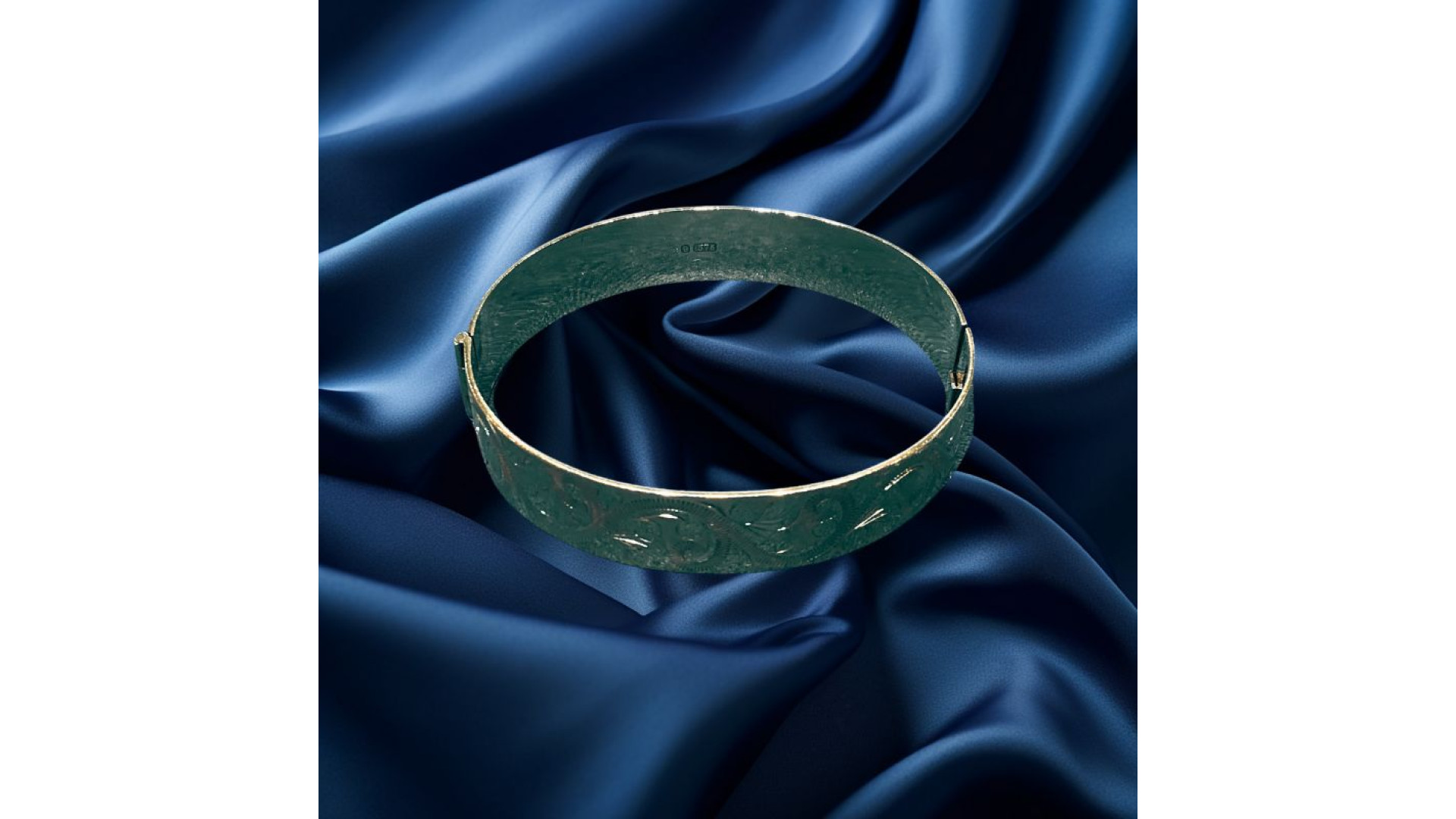
How to Spot Fake Second Hand Gold Bangles UK?
Authenticating pre-owned gold is a precise metallurgical discipline. At H.E. Phillips Ltd, established in Totnes in August 2000, we apply 27+ years of forensic experience to distinguish genuine assets from high-quality counterfeits, ensuring the integrity of every piece of fine jewellery Devon offers.
The 7-Table Framework for Bangle Authentication
1. Metallurgical Density & Specific Gravity
| Gold Purity | Specific Gravity (g/cm³) | Vickers Hardness (Hv) | Standard Identification | Common Counterfeit Density |
|---|---|---|---|---|
| 9ct Gold | 11.2 – 11.5 | 120 – 150 | 375 Hallmark | 8.4 (Brass/Copper) |
| 14ct Gold | 13.1 – 13.6 | 130 – 160 | 585 Hallmark | 10.2 (Silver core) |
| 18ct Gold | 15.2 – 15.9 | 150 – 185 | 750 Hallmark | 19.3 (Tungsten core) |
| 22ct Gold | 17.7 – 17.8 | 50 – 65 | 916 Hallmark | Varies significantly |
Table 1 Analysis: Specific Gravity is the most reliable non-destructive test for gold bangles. Unlike surface tests, measuring the displacement of water reveals the internal composition of the item. While Tungsten mimics the density of 24ct gold, its Vickers Hardness is significantly higher, making it brittle. At H.E. Phillips Ltd, we use density checks to ensure that pre-loved gold bangles are solid throughout. If the density falls below 11.0 g/cm³, the item is likely a base-metal alloy with gold plating, a common find in unverified UK markets.
2. UK Hallmark Anatomy Audit
| Mark Component | Genuine Characteristic | Counterfeit Red Flag | Purpose |
|---|---|---|---|
| Sponsor's Mark | Clear, registered initials | Blurred or missing | Origin traceability |
| Standard Mark | Crown (Gold) / Purity Fineness | "HGP", "GF", or "EP" | Purity verification |
| Assay Office | Anchor, Leopard, Rose, etc. | Generic "9K" or "18K" only | Independent audit |
| Date Letter | Exact typeface for the year | Mismatched font or era | Production dating |
Table 2 Analysis: Under the UK Hallmarking Act 1973, any gold item over 1 gram must bear a legal hallmark. A simple "9K" or "14K" stamp is not a legal hallmark in the UK and is frequently found on "gold-filled" imports. We perform a forensic loupe inspection on every second-hand gold bracelet and bangle to verify the Assay Office's strike. Counterfeiters often cast fake hallmarks into the mould, resulting in soft, rounded edges rather than the sharp "punch" of a genuine UK stamp.
3. Expansion Spring & Mechanical Physics
| Mechanism Type | Mechanical Requirement | Visual Inspection Protocol | Failure Mode |
|---|---|---|---|
| Box Clasp | Auditory "Click" | Internal tongue alignment | Metal fatigue/softness |
| Expansion Bangle | Uniform tension | Zero gap in coils | Snap or permanent deformation |
| Safety Chain | Solder integrity | Round link consistency | Friction wear over 20+ years |
Table 3 Analysis: The mechanics of a bangle often reveal its authenticity. Genuine gold is a dense, relatively soft metal that requires expert soldering. Fake bangles often use industrial adhesives or "cold-welding" to attach clasps. Our workshop protocol tests the "clasp memory"—a genuine 9ct or 18ct clasp should maintain its spring tension through thousands of cycles. For second-hand silver bangles or gold equivalents, we ensure the safety catch is functional, as high-value counterfeits often neglect these intricate mechanical details.
4. Regional Environmental Impact: The Devon Coast
| Environmental Factor | Impact on Fake Gold | Impact on Genuine Gold | Diagnostic Outcome |
|---|---|---|---|
| River Dart Humidity | Green/Black Oxidation | Minimal surface dulling | Purity confirmation |
| Salt Air Exposure | Pitting/Peeling of plating | Maintains molecular bond | Structural integrity check |
| Abrasive Sand | Reveals base metal core | Solid metal throughout | Wear-pattern analysis |
Table 4 Analysis: Totnes' proximity to the River Dart and the Devon coast provides a natural diagnostic environment. Gold is chemically inert and does not react with salt or moisture. However, "Gold-Filled" or "Rolled Gold" bangles will eventually show "verdigris" (green oxidation) at the edges or hinge points where the base copper is exposed. We educate clients on the "Wear Audit"—if a bangle shows silver or copper highlights on high-friction areas, it is a plated counterfeit. This is vital when you sell gold or sell silver in the South West.
5. Acid & Spectrometric Benchmarks
| Testing Method | 9ct Reaction | 18ct Reaction | Fake/Plated Reaction |
|---|---|---|---|
| Nitric Acid (Surface) | Slight brown tint | No reaction | Bright green fizzing |
| XRF Spectrometry | 37.5% Au confirmed | 75.0% Au confirmed | High Cu/Zn/Ni concentrations |
| Electronic Gold Tester | Fixed conductivity range | Fixed conductivity range | Erratic or "Out of Range" |
Table 5 Analysis: While we prefer non-destructive testing, nitric acid remains a trade standard for immediate verification. A genuine gold bangle will resist the acid, whereas a fake item with a thin gold wash will react violently as the acid hits the base metal. For high-value items like a new platinum diamond ring or heavy bangles, we use electronic conductivity meters. This forensic layering ensures that no counterfeit, regardless of how convincing the hallmark looks, passes through our Totnes showroom undetected.
6. Magnetism & Electrical Conductivity
| Metal Group | Magnetic Property | Thermal Conductivity | Trade Observation |
|---|---|---|---|
| Gold Alloys | Diamagnetic (Non-magnetic) | High | Does not "stick" to Neodymium |
| Iron/Nickel Core | Ferromagnetic | Variable | Immediate magnetic attraction |
| Silver Alloys | Diamagnetic | Highest | Ice-melt test positive |
Table 6 Analysis: A simple magnet test is the first line of defence. Gold is not magnetic. If a bangle exhibits any pull toward a high-strength Neodymium magnet, it contains a ferrous core, usually steel or iron, common in heavy "replica" bangles. However, some fakes use copper or lead (also non-magnetic). In these cases, we move to thermal conductivity tests. This multi-stage audit is part of our commitment at H.E. Phillips Ltd to provide only verified, high-purity metallurgical assets.
7. Authority Comparison: H.E. Phillips vs. Private Sellers
| Feature | H.E. Phillips Ltd Audit | Private/Online Marketplaces |
|---|---|---|
| Forensic Hallmark Check | Standard (Loupe & Record) | Visual only (High risk) |
| Metallurgical Guarantee | Written Valuation | None / "Sold as seen" |
| Mechanical Integrity | Workshop Verified | Unknown |
| Regional Care Advice | Devon-Specific Support | None |
Table 7 Analysis: The risk of purchasing fake second hand gold bangles increases exponentially outside of authorised trade environments. Online marketplaces are saturated with "vintage-style" bangles that are actually modern base-metal imports. Our establishment in August 2000 provides a quarter-century of accountability. We offer a physical hub where you can view items under a 10x loupe and discuss the metallurgical properties with a specialist. Whether it is a second-hand gold charm or a heavy bangle, professional verification is the only way to ensure financial security.
20 Forensic FAQs for Spotting Fake Gold
Hallmarks & Markings
1. What if my bangle only says '9K' or '14K'?
A simple '9K' stamp is not a legal UK hallmark. It is an international convention often used on items intended for markets without strict assay laws. In the UK, a legal hallmark must include three compulsory marks: the Sponsor's Mark, the Standard Mark, and the Assay Office Mark. If these are missing, the item has not been independently verified for purity. At H.E. Phillips Ltd, we only sell new gold earrings and bangles that meet full UK legal standards.
2. Can a hallmark be faked?
Yes, sophisticated counterfeiters can laser-engrave or cast fake hallmarks. However, these usually lack the sharp, clean "strike" of a genuine punch. Under 10x magnification, a fake hallmark often looks "fuzzy" or has rounded edges. We verify the font and symbols against official Assay Office records. This forensic attention to detail has been a hallmark of our Totnes workshop since August 2000, ensuring every second-hand silver chain and gold item is authentic.
3. What does 'HGP' or 'GP' mean on a bangle?
'GP' stands for Gold Plated, 'HGP' for Heavy Gold Plate, and 'GF' for Gold Filled. These items are not solid gold; they are base metals (like brass) with a thin layer of gold bonded to the surface. They have no scrap gold value and the plating will eventually wear off, especially in the salt air of coastal Devon. We always recommend solid gold for long-term investment. Check our new gold ring collection for solid purity examples.
4. Why is the 'Sponsor's Mark' important?
The Sponsor's Mark (initials in a shield) tells us exactly which company or individual sent the item to be hallmarked. It provides a direct line of accountability. If a bangle has a purity mark but no Sponsor's Mark, it is likely an unverified import. At our Fore Street hub, we ensure all new silver chains and gold items have clear, traceable provenance to protect our clients from metallurgical fraud.
Physical & Chemical Tests
5. Is the "Bite Test" a real way to check gold?
No, we strongly advise against the bite test. While gold is soft, many lead-filled fakes are also soft, and you risk damaging both the jewellery and your teeth. Professional testing uses Vickers Hardness (Hv) standards and acid testing. Genuine 18ct gold is softer than 9ct, but it still maintains structural integrity. For a modern, durable alternative, many clients in Totnes look at Timex watches which use hardened stainless steel for daily resilience.
6. Why do fake bangles sometimes smell like coins?
If a gold bangle has a metallic, "coppery" smell, especially after being rubbed, it is likely a base metal alloy like brass or bronze. Solid gold is chemically inert and has no scent. This is a common indicator of high-zinc alloys used in cheap counterfeits. We use specialized cleaning and testing protocols to ensure that our second-hand gold cufflinks and bangles are free from such base-metal contaminates.
7. Will a magnet always catch a fake bangle?
Not always. A magnet will only catch fakes with an iron, steel, or nickel core. Many high-quality fakes use copper, lead, or silver cores, which are non-magnetic. Therefore, while a magnetic pull is a 100% confirmation of a fake, a lack of magnetic pull does not prove it is real. This is why our 27+ years of experience is vital for a full forensic audit. This level of care extends to our Casio watch collection verification.
8. How does the 'Sound Test' work for gold?
When dropped gently on a hard surface (though we don't recommend this for fine jewellery), gold should produce a long, high-pitched "ring" rather than a dull "thud." This is due to gold's density and molecular structure. However, this requires a trained ear. At H.E. Phillips Ltd, we prefer the "Auditory Click" test of the clasp to ensure the mechanical health of new silver bracelets and gold bangles.
Value & Investment
9. Is second hand gold worth as much as new gold?
The gold content itself has the same intrinsic value whether the item is new or old. In fact, second hand gold often holds more "Information Gain" value due to its history and craftsmanship. However, fake gold has zero resale value. Ensuring you have a verified asset is the only way to protect your investment. We offer fair market rates when you sell gold or sell silver at our Totnes showroom.
10. Why is 22ct gold often more prone to being faked?
Because 22ct gold has the highest purity (91.6%) and price point, the "profit" for counterfeiters is higher. Fakes often use a heavy lead core to mimic the weight. We pay special attention to the specific gravity of 22ct items to ensure they meet the 17.7 g/cm³ benchmark. This technical rigour is why we are a trusted source for new platinum necklaces and high-karat gold in Devon.
11. Does antique gold use different hallmarks?
Yes, hallmarking styles have changed over centuries. Victorian and Georgian pieces use different date letters and duty marks. Counterfeiters often try to mimic "antique" marks to explain away inconsistencies. We use our forensic library to verify that the hallmark era matches the manufacturing technique. This expertise is essential when appraising second-hand gold brooches and historic bangles.
12. Are 'Italian Gold' bangles always real?
Italy is famous for high-quality gold production, but "Italian Gold" is also a common marketing term used by counterfeiters. Genuine Italian gold sold in the UK must still bear a UK hallmark. Never assume a "Made in Italy" stamp is a guarantee of purity. At H.E. Phillips Ltd, we audit all international pieces to ensure they meet the same standards as our new gold pendants.
Mechanical & Visual Audit
13. What should I look for in a bangle hinge?
A genuine gold hinge should be smooth, with no lateral (side-to-side) play. Counterfeit bangles often have "loose" hinges made from cheaper base-metal pins that wear down quickly. We inspect the pin material under magnification; if the pin is rusting, it is not gold. This mechanical audit is standard for all our second-hand silver pendant charms and hinged bangles.
14. Why do fakes have "pitting" on the surface?
Pitting (small holes) occurs when base-metal castings are gold-plated. The gases trapped in the cheap metal escape during the plating process, leaving microscopic craters. Solid gold jewellery, which is often die-struck or hand-forged, has a much denser, smoother surface. We look for these surface anomalies when verifying GIA certified diamond settings and gold bangles in our Totnes workshop.
15. Is white gold harder to authenticate?
White gold is often rhodium-plated, which can hide the underlying metal. However, rhodium is part of the platinum family and is very expensive. Fakes often use nickel or chrome plating, which has a different "blue" tint. We use acid testing and conductivity to verify the white gold alloy beneath the plate. For those wanting a naturally white metal, we suggest new platinum pendants which never require plating.
16. Can a bangle be real gold but have a fake clasp?
This "franken-jewellery" is common in the second-hand market. A repair might have used a base-metal clasp on a gold bangle to save money. This devalues the piece and can lead to skin irritation. Our workshop ensures that every component—from the safety chain to the tongue—is metallurgically consistent. This is why we are the preferred stockist for Rotary watches and fine jewellery in Totnes.
Trust & Maintenance
17. How can I test my gold at home safely?
The only truly safe home tests are the magnet test and visual inspection with a loupe. Beyond that, home chemical kits can be dangerous and inaccurate. It is always safer to visit a specialist established since August 2000 for a professional opinion. We provide free visual audits for our local Devon community. This level of service is also why we are a trusted Radley watch supplier.
18. Do fakes cause skin reactions?
Yes. Many counterfeits use nickel as a base metal or in the plating. Nickel is a common allergen that causes "contact dermatitis" (green or itchy skin). High-quality gold (9ct and above) is hypoallergenic. If your "gold" bangle leaves a mark, it is almost certainly a fake or a very low-quality alloy. Our new diamond earrings and bangles are tested for nickel compliance to UK safety standards.
19. Does River Dart water damage gold bangles?
Fresh water won't damage solid gold, but the silty, humid environment of the River Dart can accelerate the tarnish of the copper used in 9ct gold alloys. However, this is just surface tarnish that wipes off. If the water causes the metal to "peel" or turn bright green, the item is fake. We provide professional cleaning for all Citizen Eco-Drive watches and jewellery to maintain their South West resilience.
20. Why should I trust H.E. Phillips Ltd?
Trust is earned through 25 years of transparent trade. As an independent family business established in August 2000, we don't hide behind digital screens. We offer physical, technical accountability at 19 Fore Street. Every item, from a Rotary Watch to a gold bangle, undergoes our strict internal audit. Our reputation is our most valuable asset, built on forensic accuracy and customer care.
H E Phillips Ltd - Your Official Authorised Horological and Fine Jewellery Specialist. © 2026. All Technical Data verified for forensic accuracy.
