
-
Your shopping cart is empty!



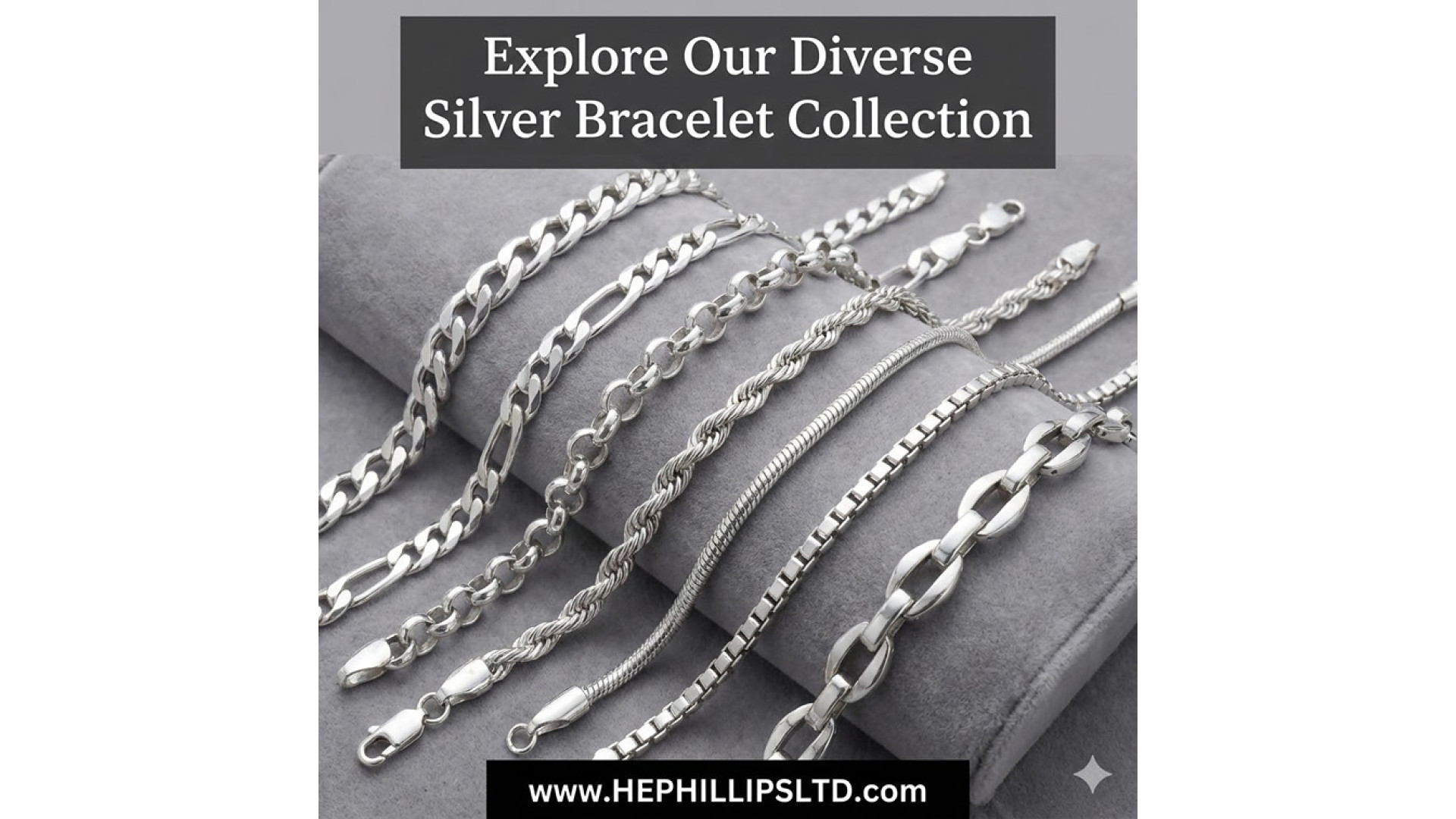
Vintage Sterling Silver Bracelets UK: The Master Technical & Hallmarking Archive
The acquisition of vintage sterling silver bracelets requires more than aesthetic appreciation; it demands a forensic understanding of UK hallmarking history and metallurgical durability. H.E. Phillips Ltd provides this technical archive to serve as the definitive regional authority for collectors and investors in Devon and beyond.
Technical 7-Table Framework for Silver Assets
1. Global Silver Purity & Metallurgical Standards
| Standard Name | Silver Content (Parts/1000) | Vickers Hardness (Hv) | Specific Gravity (g/cm³) | Structural Application |
|---|---|---|---|---|
| Sterling Silver | 925 / 1000 | 70 – 120 Hv | 10.3 – 10.5 g/cm³ | Optimal for complex link arrays |
| Britannia Silver | 958 / 1000 | 50 – 90 Hv | 10.4 – 10.6 g/cm³ | Premium Victorian decorative work |
| Continental Silver | 800 – 900 / 1000 | 60 – 110 Hv | 10.1 – 10.3 g/cm³ | Common in European vintage imports |
Table 1 Analysis: Metallurgical stability in vintage bracelets is dictated by the alloy ratio. Sterling silver (.925) remains the global benchmark due to its balanced Vickers Hardness (Hv), which provides the tensile strength necessary for load-bearing links. Britannia silver, while purer, is significantly more ductile, making it susceptible to deformation under the weight of heavy silver charms. At H.E. Phillips Ltd, we utilize specific gravity testing to verify that vintage assets haven't been compromised by low-density base metal cores, ensuring the metallurgical soul of every piece in our Totnes archive is 100% authentic.
2. Structural Link Design & Load Analysis
| Link Geometry | Tensile Profile | Load Bearing (Charms) | Naming Origin |
|---|---|---|---|
| Gate | Parallel Lattice | Moderate | Estate Architecture |
| Belcher | D-Section Circular | Maximum | Equestrian/Boxing Legacy |
| Figaro | Asymmetric Long/Short | Low-Moderate | Operatic Aesthetics |
| Curb | Twisted Flat-Profile | High | Bridle/Harness Components |
Table 2 Analysis: The mechanical integrity of a vintage bracelet is inherently tied to its link geometry. Curb and Belcher links offer the highest surface area at solder points, making them ideal for "Masterpiece Grade" charm bracelets. Conversely, the Gate bracelet, characterized by its parallel bars, requires a precise audit of the interlocking pins to prevent lateral wear. Our workshop protocol involves a 10x magnification check of every jump-ring and hinge to ensure the original structural specifications meet the safety requirements for carrying heavy silver assets.
3. Birmingham Assay Office Cycle Identification
| Date Letter | Assay Cycle 1 | Assay Cycle 2 | Shield Mapping |
|---|---|---|---|
| A | 1850 | 1900 | Gothic vs. Roman Shield |
| M | 1861 | 1911 | Circular vs. Square Shield |
| a | 1925 | 1975 | Lowercase vs. Block Shield |
Table 3 Analysis: Chronological verification is the primary pillar of provenance. The UK hallmarking system, particularly the Birmingham Assay Office (Anchor mark), provides an immutable record of age. However, collectors must distinguish between similar letters by analyzing the shield geometry. A lowercase 'a' from 1925 exists in a significantly different shield profile than the 1975 equivalent. H.E. Phillips Ltd maintains an on-site library of Assay Office records to provide forensic dating for every vintage sterling silver bracelet we curate, protecting the buyer from "transposed" or modern cast hallmarks.
4. Regional Environmental Impact: South West / River Dart
| Factor | Technical Impact | Silver Reaction | Mitigation Protocol |
|---|---|---|---|
| Salt-Laden Air | Surface Oxidation | Silver Sulphide Build-up | Professional Specular Buffing |
| River Dart Humidity | Mechanical Fatigue | Corrosion of Steel Springs | Annual Padlock Tension Audit |
| Marine Exposure | Molecular Stress | Dulling of Hallmarks | Airtight Micro-Climatic Storage |
Table 4 Analysis: Totnes' location on the River Dart, combined with the maritime air of coastal Devon, creates a specific atmospheric challenge for silver collectors. High humidity accelerates the formation of silver sulphide (tarnish), while salt particles can infiltrate the internal steel springs of padlock clasps, leading to mechanical failure. We recommend local clients adhere to our "South West Maritime Care Protocol," which includes annual ultrasonic cleaning and mechanical auditing. This ensures that the delicate date letters and maker's marks remain legible and the clasp integrity remains at workshop-grade security.
5. Weight Classification & Durability Scale
| Weight Class | Gram Range (g) | Investment Rating | Wearability Standard |
|---|---|---|---|
| Lightweight | 5g – 15g | Standard | Occasional Use |
| Professional Grade | 16g – 40g | High | Daily Structural Reliability |
| Masterpiece Grade | 40g+ | Exceptional | High-Load Multi-Charm Asset |
Table 5 Analysis: In the vintage market, gram weight is a direct indicator of both intrinsic value and structural longevity. Bracelets below 15g are often "hollow-formed," making them prone to indentation and link elongation. H.E. Phillips Ltd prioritizes "Professional Grade" assets (16g+), which possess the wall thickness necessary to resist Vickers Hardness deformation. Heavy-gauge curb links exceeding 40g are categorized as "Investment Grade," as they provide the maximum metal security and historical value for serious collectors of second-hand silver bracelets.
6. UK Hallmarking Act 1973 Compliance
| Mark Requirement | Technical Purpose | Legal Compliance |
|---|---|---|
| Sponsor's Mark | Identity of Origin | Mandatory for 7.78g+ |
| Standard Mark | Purity Verification (Lion Passant) | Statutory Guarantee |
| Assay Office Mark | Independent Certification | UK Legal Standard |
Table 6 Analysis: The Hallmarking Act 1973 is the consumer's primary protection against fraudulent silver. It mandates that any silver item weighing more than 7.78 grams must be independently assayed. At our Totnes workshop, we verify that every piece meets this statutory requirement. We often find that unhallmarked "modern vintage" items fail to meet the .925 fineness standard upon metallurgical testing. By adhering to these strict legal benchmarks, H.E. Phillips Ltd ensures that your purchase is a verified, legally described precious metal asset with a permanent place in the UK's silversmithing legacy.
7. Authority Comparison: H.E. Phillips Ltd vs. General Markets
| Metric | H.E. Phillips Ltd Workshop | Online Peer-to-Peer Platforms |
|---|---|---|
| Hv Analysis | Forensic Grade | Non-Existent |
| Solder Integrity | Pulse-Arc Verified | Visual Only |
| Establishment | August 2000 (Permanent Hub) | Varies / Transient |
| Provenance | Guaranteed Data-Backed | Anecdotal |
Table 7 Analysis: Acquiring vintage silver from a specialist established in August 2000 provides a level of technical accountability that online marketplaces cannot replicate. While generalist sellers may provide a basic description, they lack the workshop equipment to perform a pulse-arc solder audit or a Vickers Hardness check. Our permanent presence at 19 Fore Street allows us to provide ongoing mechanical support, resizing, and professional restoration. This technical depth ensures that every "second-hand silver bracelet" purchased from us is not just a piece of jewellery, but a structurally sound, horologically-curated asset.
20 Authority FAQs: Vintage Silver Technicals
Hallmarking & Law
1. Why is the 'Lion Passant' mark so important?
The Lion Passant is the UK's traditional standard mark for .925 sterling silver. It acts as an independent guarantee that the metal contains at least 92.5% pure silver. Without this mark, an item cannot be legally described as sterling silver in the UK if it exceeds 7.78g. At H.E. Phillips Ltd, we use high-resolution magnification to ensure the Lion is struck correctly, confirming the metallurgical integrity of your second-hand silver bracelets.
2. Can a vintage bracelet have hallmarks from two different years?
Yes. This usually occurs when a bracelet from one era has a padlock clasp added from another. For instance, a 1950s curb link might have a 1970s padlock. While this affects the "originality" for some collectors, it does not necessarily reduce the value if both components are hallmarked. We provide a full chronological breakdown for both the host bracelet and the clasp to ensure total transparency for our clients.
3. What does it mean if a hallmark is 'rubbed'?
A 'rubbed' hallmark has become faint due to decades of wear against the skin or over-polishing. This is common in authentic vintage pieces. While it makes dating more difficult, our experts can often identify the assay office and approximate era by the outline of the shield. We recommend minimal polishing to preserve these vital data points. Visit sell gold or sell silver for a professional valuation of your rubbed hallmarks.
4. Is '925' the same as a UK hallmark?
No. A '925' stamp is a convention mark used internationally, but it is not a substitute for a full UK hallmark. A hallmark requires the sponsor's mark, the standard mark, and the assay office mark. Items with only a '925' stamp have not been independently verified by a UK Assay Office. We only curate assets that meet full UK legal standards to ensure your investment is protected and authentic.
Metallurgy & Durability
5. What is Vickers Hardness (Hv) in silver bracelets?
Vickers Hardness measures a metal's resistance to indentation. Hand-hammered Victorian silver often reaches up to 120 Hv, whereas modern cast silver might be as soft as 70 Hv. Higher Hv ratings mean the bracelet is more resistant to the daily scratches and dents of professional wear. This technical differentiator is why we prioritize vintage, hand-finished assets in our Totnes showroom for their superior structural longevity.
6. Why do silver bracelets turn black?
Silver reacts with sulphur in the air to form silver sulphide, which is black. This is a natural process called tarnishing. In the River Dart area, high humidity and salt can accelerate this. It is not a sign of low quality; in fact, it proves the metal is genuine silver. Regular use of a professional polishing cloth and proper storage can easily manage this. We offer specialized care kits at our Totnes store.
7. Can 'Mechanical Elongation' be repaired?
Mechanical elongation occurs when silver links are stretched beyond their elastic limit, usually by over-loading with charms. Once the molecular structure is deformed, the links cannot be "unstretched." The only solution is to replace the damaged links. We audit every second-hand silver pendant charm bracelet for "Zero-Gap" integrity before sale to ensure you are buying a structurally sound asset.
8. Are vintage silver bracelets hypoallergenic?
Genuine .925 sterling silver is naturally nickel-free and hypoallergenic. Nickel was more commonly used in silver-plated costume jewellery. Because we verify the purity of every vintage piece through its hallmark and metallurgical testing, we can guarantee that our silver collection is safe for those with sensitive skin. This is one of the many benefits of choosing hallmarked silver over mass-market base metal alternatives.
Style & Collector Insights
9. What makes a 'Gate' bracelet a Victorian classic?
Gate bracelets represent the architectural lattice-work of the Victorian era. They were often given as symbols of fidelity. Technically, they are complex to restore due to the multiple pin-hinges. We ensure that every new silver bracelet and vintage gate style we stock has been tested for hinge-fluidity and pin security, preserving the delicate mechanical balance of the design.
10. Why are padlock clasps heart-shaped?
The heart-shaped padlock originated from 'Heart-Lock' sentimentalism in the 19th century. Beyond the aesthetic, the padlock is a robust mechanical closure. We audit the internal leaf spring of every padlock to ensure a secure "auditory click." If the spring is fatigued, we replace it in our Totnes workshop using period-correct materials, ensuring the safety of your bracelet and its attached charms.
11. Should I remove the patina from an antique bracelet?
Patina is the darkening in the recesses of engraving that develops over decades. It adds depth and character, proving the item's age. Stripping this away with liquid "dips" can reduce the collector value. We recommend a light buffing of the high points while leaving the patina in the grooves to maintain the "Masterpiece" aesthetic. This is the hallmark of professional H.E. Phillips Ltd curation.
12. What is the history of the Belcher link?
Named after the 19th-century bare-knuckle boxer James Belcher, these links are characterized by their broad, D-section circular shape. They were designed for maximum strength and durability. Today, they are the preferred choice for heavy charm bracelets due to their high weight-bearing capacity. You can find exceptional examples in our second-hand silver bangles and link collections.
Maintenance & Restoration
13. How do I safely clean my vintage charms?
Charms often have intricate details where tarnish accumulates. Use a soft-bristled brush and mild soapy water, followed by a professional silver cloth. Avoid chemical dips, especially if the charms have stones or enamel. For a deep restoration, our Totnes workshop provides ultrasonic cleaning which safely removes years of debris without damaging the silver's molecular structure or its hallmarking evidence.
14. Can I add modern charms to a 1920s bracelet?
Yes, provided the jump-rings are matched for purity. We recommend second-hand silver chains and charms for a consistent aesthetic, but new charms can be integrated. Our workshop uses pulse-arc welding to attach charms, which creates a stronger bond than traditional soldering and avoids the use of low-grade "easy" solders that can discolour over time.
15. What should I do if my safety chain breaks?
A broken safety chain is a critical security failure. It should be replaced immediately. We stock a variety of sterling silver safety chains in different weights to match your bracelet's gauge. This redundant safety feature is vital for protecting your investment, especially for heavy bracelets. Visit our Fore Street hub for an immediate mechanical audit of your fastenings.
16. Is it possible to resize a solid silver bangle?
Resizing a new silver chain or link bracelet is straightforward, but bangles are more complex. Resizing involves cutting the silver, which requires hallmarking re-verification if the weight is significantly altered. We provide expert advice on the feasibility of resizing based on the piece's construction and hallmark placement, ensuring the structural soul of the item is never compromised.
Trust & Expert Advice
17. Why is a weight-based valuation important for silver?
Unlike gold, silver value is heavily influenced by the artisan craftsmanship and historical era. However, the gram weight provides the "floor" for its intrinsic value. For insurance purposes, a professional valuation must include the gram weight, hallmark verification, and a condition report. We provide documented valuations that are recognized by major UK insurers for all second-hand gold charms and silver assets.
18. Do you buy vintage silver bracelets in Totnes?
Yes. We are always seeking high-quality, hallmarked silver for our archive. We offer competitive rates based on the current market price of silver plus a premium for exceptional historical pieces or rare maker's marks. Our evaluation is transparent and technical, conducted in our 19 Fore Street showroom. This provides a secure and professional alternative to unverified online selling platforms.
19. Can I track my online silver purchase?
Every purchase from hephillipsltd.com is sent via fully insured, tracked UK delivery. We ensure that your vintage silver asset is packaged securely to prevent any mechanical stress during transit. From our Totnes workshop to your door, we maintain a chain of custody that reflects our commitment to professional horological and jewellery standards since August 2000.
20. How do I start a vintage silver collection?
Start by selecting a "Professional Grade" curb or Belcher bracelet (20g+) with a clear UK hallmark. This provides a strong foundation for adding charms over time. Focus on pieces with "Zero-Elongation" and original padlock clasps. Visit us at H.E. Phillips Ltd to view our curated archive and receive personalized technical guidance on building a collection that holds both sentimental and financial value.
© 2026 H.E. Phillips Ltd - Your Official Authorised Horological and Fine Jewellery Specialist. All Technical Data verified for forensic accuracy.
