-
Your shopping cart is empty!



The Lion Passant and Beyond:
Understanding UK Hallmarks on Antique Silver
Why UK Silver Hallmarks Matter
Whether
you're a seasoned collector, an antique dealer, or simply a vintage jewellery
enthusiast, understanding UK silver hallmarks is absolutely essential. These
intricate official stamps serve a crucial purpose beyond merely certifying the
purity of the silver; they offer invaluable insights into an item's origin, the
specific maker responsible for its creation, and the precise date of its
hallmarking. Among these marks, the Lion Passant stands out as one of the most
iconic symbols, instantly recognisable as a mark of English sterling silver.
However, it is merely one component of a much broader and more complex
hallmarking system that boasts a rich history dating back to the 14th century.
In this detailed, UK-focused guide, we will meticulously explain how to
interpret British silver hallmarks, commonly found on a diverse array of
antique items such as bangles, cutlery, candlesticks, and other treasured
heritage pieces. Our aim at H.E. Phillips Jewellers is to empower you
with the expertise to confidently identify and appreciate the historical
significance of genuine antique silver.
What Is the Lion Passant?
The
Lion Passant, depicted as a walking lion with one forepaw raised, is arguably
the most traditional and enduring hallmark for sterling silver (which denotes
92.5% pure silver content) in England. Its presence on a piece of silver
signifies that the item has been tested and guaranteed to meet the sterling
standard by an English Assay Office. This iconic symbol carries significant
historical weight and continues to be recognised globally as a mark of quality
and authenticity. The Lion Passant represents legal sterling silver under UK
law, having been introduced in the 1500s. Today, it remains a widely recognised
symbol that assures the buyer of the silver's purity. Crucially, this mark is
often accompanied by other essential hallmarks, including the Assay Office
mark, the maker’s mark, and a date letter, all of which contribute to the
complete story of the silver item. Therefore, if your antique silver bears a
Lion Passant, it is a very strong and reliable indicator that it is genuine
sterling silver, specifically hallmarked in England. This commitment to
verifiable quality is something we deeply value at hephillipsltd, ensuring our customers acquire
pieces with true provenance.
Understanding the Full UK Hallmark Structure
UK
silver hallmarks are typically composed of up to five distinct elements. When
interpreted together, these marks provide a comprehensive authentication of the
piece’s origin, purity, and historical journey. Each element plays a vital role
in narrating the item's unique story and verifying its authenticity.
1. Standard or Purity Mark
This
crucial mark definitively confirms the specific silver content within the item.
For example, "925" or the Lion Passant both signify
sterling silver, which is 92.5% pure silver. The Britannia mark
denotes a slightly higher purity silver, specifically 95.8%.
Historically, a Crowned Harp was used for Irish sterling silver, while
the Thistle or Lion Rampant indicated Scottish silver prior to 1975.
These marks provide immediate assurance of the precious metal's purity.
2. Assay Office Mark
This
specific symbol indicates precisely where the silver item was tested and
hallmarked. Each of the four official UK Assay Offices has its unique symbol: a
Leopard’s Head for London, an Anchor for Birmingham, a Rose
for Sheffield, and a Castle for Edinburgh. In Ireland, the Hibernia
symbol along with a Harp designated Dublin. Identifying this mark helps
pinpoint the geographical origin of the hallmarking process.
3. Sponsor’s or Maker’s Mark
This
mark typically consists of two or three initials, often enclosed within a
distinctive shield shape or other unique punch. Its purpose is to identify the
individual person or the specific company that registered the item for
hallmarking. For example, the initials "WH" might refer to
William Hutton, a prominent 19th-century silversmith, allowing collectors to
trace the item back to its original manufacturer or the entity responsible for
its submission to the Assay Office. When exploring items like second hand silver bangles, examining the maker's mark can
reveal fascinating details about its journey.
4. Date Letter
Each
Assay Office meticulously assigns a unique letter style for every year. The
letter's specific shape, font, and casing (whether it's a capital or lowercase
letter) collectively indicate the exact year the item was assayed and
hallmarked. To accurately identify the date, it is essential to use an official
UK Assay Office date letter chart, as these charts provide the precise
correlation between the letter and the year for each office. This system offers
incredible precision for dating antique silver pieces.
5. (Optional) Duty Mark
This
is a historical mark that was used between 1784 and 1890. It typically
features the head of the reigning monarch at the time. The presence of a Duty
Mark signifies that a tax (duty) was paid on the silver item during that
specific period. While not always present, its appearance provides an
additional layer of historical context to the piece.
Example: How to Read a British Hallmark
To
illustrate how these elements come together, let's consider a practical
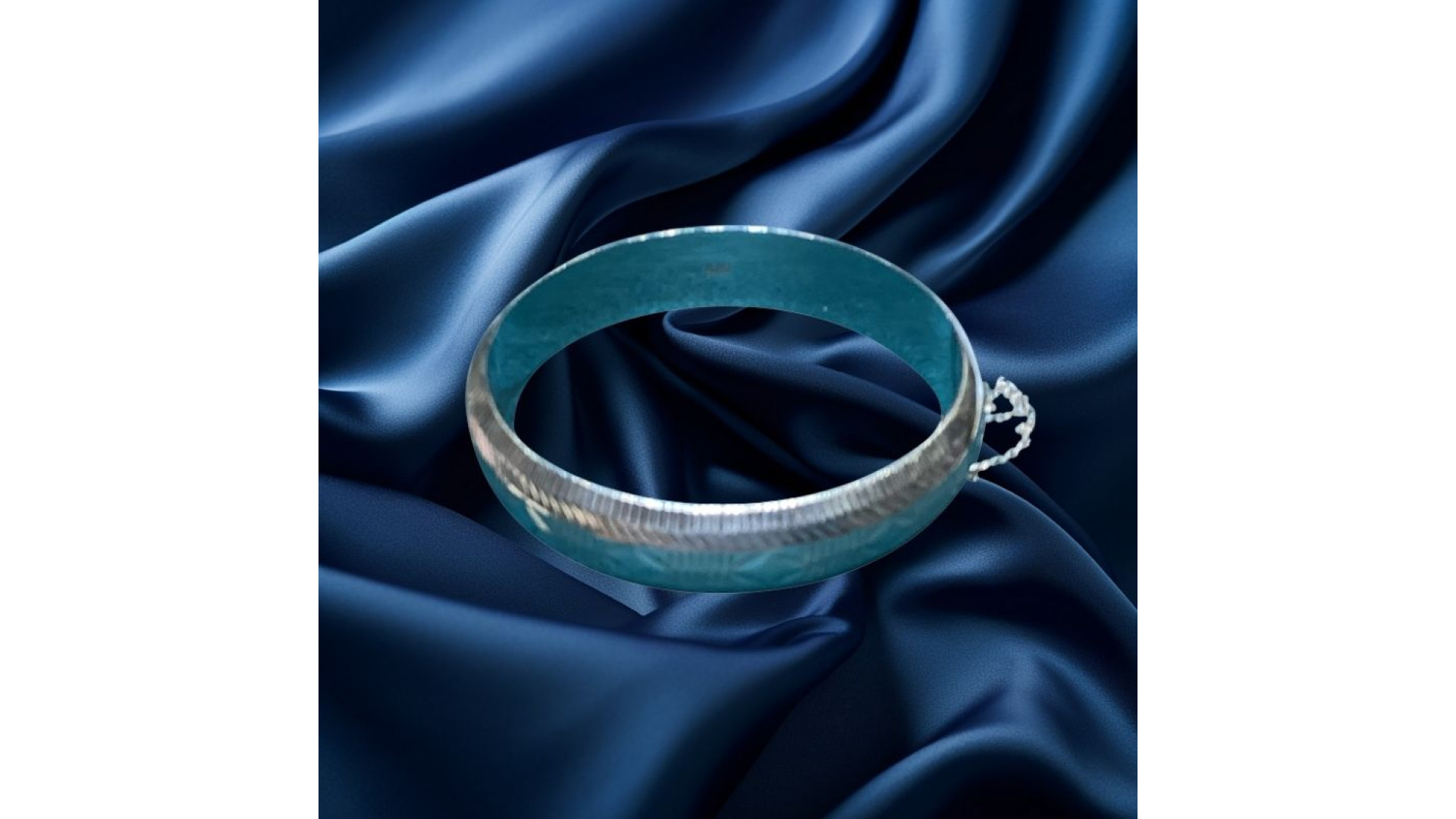
example. Imagine you are inspecting an antique silver bangle and observe the
following hallmarks stamped clearly on its surface: a Lion Passant, an Anchor
symbol, the initials "JH" enclosed within a rectangular shape,
and a date letter "k" presented in a square.
By
interpreting these individual marks, you can deduce the complete story of the
piece. The Lion Passant immediately confirms that the bangle is made of
genuine sterling silver. The Anchor symbol identifies the Assay Office
where the silver was tested and hallmarked as Birmingham. The initials "JH"
within the rectangle indicate that the item was made by a silversmith or
manufacturer whose registered initials were JH. Finally, by consulting an
official Birmingham Assay Office date chart, the date letter "k"
in a square would pinpoint the exact year of hallmarking as 1909. Each
hallmark, therefore, acts as a crucial clue, and when combined, they
collectively unveil the full narrative of your antique item’s origin, ensuring
its authenticity and enhancing its historical significance. This detailed
understanding allows you to appreciate the depth of history in every piece of
antique jewellery, including our exquisite second hand silver bangles.
Hallmarking Before and After 1975
The
system of UK hallmarking has evolved over centuries, with a significant shift
occurring with the introduction of the Hallmarking Act 1973, which became fully
enforced from 1975. Prior to this act, regional variations in
hallmarking practices were more prominent. For instance, Scotland traditionally
used either the Thistle or the Lion Rampant as its purity mark,
while Ireland utilised the Harp and the Hibernia symbol to denote
sterling silver hallmarked in Dublin. The Britannia standard, which signifies a
higher purity of silver (95.8%), was actually mandatory for a specific
period between 1697 and 1720 before becoming an optional standard
thereafter. After 1975, UK hallmarking became considerably more unified
across all Assay Offices, standardising the marks and regulations. However, it
is important to note that genuine antique pieces will, by their very nature,
still reflect these earlier, varied practices and regional specificities,
providing a fascinating insight into the history of British silversmithing.
This continuity of hallmarking, while adapting over time, underscores the
enduring commitment to quality in British precious metal items, something that H.E.
Phillips Jewellers continues to uphold in its selection of new and old
silver and gold jewellery.
What If a Silver Item Has No Hallmark?
In
the UK, it is a legal requirement that any silver item weighing over 7.78
grams must be hallmarked by an official Assay Office. This regulation
ensures consumer protection and guarantees the silver's purity. Therefore, if
you possess an antique silver piece that appears to be silver but lacks a
visible hallmark, there are several possible explanations to consider. The item
might simply be underweight, falling below the 7.78g legal
threshold for mandatory hallmarking. Alternatively, it could be foreign made
and therefore not subject to UK hallmarking laws unless it was imported and
subsequently submitted for assay in the UK. A common reason for the absence of
hallmarks is that the item is actually silver-plated rather than being
solid silver; plated items are not required to be hallmarked. Lastly,
particularly with very old or frequently used items, the hallmarks may simply
have become worn and partially faded over many years of handling and
polishing, making them difficult to discern. In such cases, always use a
jeweller’s loupe and inspect all surfaces closely, including the edges, clasps,
and less exposed areas, as marks can sometimes be subtle or located in
inconspicuous places. For genuinely unmarked or questionable pieces, consider
professional XRF (X-ray fluorescence) testing, which can non-invasively
determine the precise metal composition. At hephillipsltd, we ensure all our hallmarked items
meet these rigorous standards.
Where to Buy Hallmarked Antique Silver in the UK
For
significant purchases, whether for investment purposes or with future resale in
mind, it is always advisable to acquire hallmarked antique silver from trusted
UK sellers. Reputable dealers prioritise transparency and authenticity,
ensuring you receive genuine, verifiable pieces. Such sellers consistently
provide clear, high-resolution hallmark photos within their listings or upon
request, allowing you to meticulously examine the marks yourself. They will
also reference specific Assay Office details and the date letter information,
demonstrating their expertise and the item's verifiable history. Furthermore,
where applicable, they may offer certificates of authenticity for higher value
or particularly rare pieces. Recommended sources for acquiring hallmarked
antique silver in the UK include H.E. Phillips Jewellers, who are
experts in pre-owned and antique silver based in Totnes, Devon. We meticulously
verify all hallmarks, offering peace of mind to our customers. Another
excellent option is Fellows Auctioneers, a prominent Birmingham-based auction
house renowned for its hallmark-verified listings and detailed item
descriptions. For online platforms such as Etsy UK and eBay UK, it is crucial
to filter your searches by "UK sellers" and always request close-up
photos of hallmarks before making any purchase, ensuring due diligence. You can
browse our verified collection by visiting hephillipsltd.
Quick Reference: UK Hallmark Elements
Understanding
the various elements of a UK hallmark is crucial for authenticating and
appreciating antique silver. The Lion Passant explicitly means English
sterling silver, indicating a purity of 92.5%. The Britannia Mark
signifies a slightly higher-purity silver, specifically 95.8%. The Assay
Mark identifies the specific Assay Office where the item underwent testing.
The Maker's Mark identifies the individual or company who submitted the
piece for hallmarking, tracing its origin. Finally, the Date Letter indicates
the precise year of assay, though its style varies by office and era. These
elements combined provide a comprehensive narrative of each piece of silver.
Frequently Asked Questions (FAQ)
Q1:
What is a UK hallmark and why is it important? A UK hallmark is a series of official marks stamped onto
precious metal items by one of the four official Assay Offices in the United
Kingdom (London, Birmingham, Sheffield, Edinburgh). Its importance lies in the
fact that it guarantees the purity of the metal, identifies the Assay Office,
and includes the maker's or sponsor's mark. For items exceeding a specific
weight, hallmarking is a legal requirement, providing a crucial layer of
consumer protection and ensuring authenticity for collectors and buyers.
Q2:
What is the minimum weight for an item to require a UK hallmark? In the UK, any silver item intended
for sale that weighs over 7.78 grams must be hallmarked by law. This threshold
ensures that larger pieces, which typically carry more significant value, are
officially verified for their precious metal content. Smaller items below this
weight are not legally required to be hallmarked, though many reputable
jewellers may still choose to hallmark them.
Q3:
Can a silver item be genuine sterling silver if it doesn't have a hallmark? Yes, a silver item can be genuine
sterling silver even if it doesn't have a hallmark, but this is usually only
for items weighing under 7.78 grams, as these are exempt from mandatory
hallmarking. Very old items might also have extremely worn or faded hallmarks
that are no longer visible. For larger, un-hallmarked items, it is highly
advisable to seek professional verification to confirm their authenticity.
Q4:
What is the difference between sterling silver and Britannia silver? Sterling silver has a purity of
92.5% pure silver (marked as "925" or with the Lion Passant).
Britannia silver, on the other hand, is a higher purity standard, containing
95.8% pure silver (marked with the Britannia symbol). Britannia silver was
mandatory for a period between 1697 and 1720, but it is now an optional,
higher-grade standard.
Q5:
How can I tell which Assay Office hallmarked my silver item? You can identify the Assay Office
by looking for its unique symbol within the hallmark. The Leopard's Head
represents London, an Anchor for Birmingham, a Rose for Sheffield, and a Castle
for Edinburgh. If your item has an Irish hallmark, you might see the Hibernia
symbol with a Harp for Dublin.
Q6:
What is a sponsor's mark and why is it included? A sponsor's mark, also known as a maker's mark, consists of
the initials or a unique symbol registered by the individual or company
responsible for submitting the item for hallmarking. It's included to identify
the manufacturer or importer, providing accountability and traceability within
the jewellery and silversmithing industry.
Q7:
How do I read the date letter on a UK hallmark? Reading a date letter requires consulting an official UK
Assay Office date letter chart. Each Assay Office uses a unique series of
letters, changing annually, often with variations in font style, casing
(uppercase/lowercase), and shield shape. These charts are widely available from
Assay Offices or reputable hallmark reference books and websites.
Q8:
Are older hallmarks different from modern ones? Yes, older hallmarks can differ significantly from modern
ones due to changes in legislation and standardisation over time. For example,
before the Hallmarking Act 1973 (enforced from 1975), there were more regional
variations in purity marks (like the Scottish Thistle or Irish Harp) and the
optional Duty Mark was used between 1784 and 1890.
Q9:
What is a Duty Mark?
A Duty Mark is a historical hallmark feature that appeared on UK silver items
between 1784 and 1890. It typically depicts the head of the reigning monarch
(e.g., George III, Victoria) and signified that a government tax (duty) had
been paid on the item at the time of its hallmarking.
Q10:
What should I do if I suspect my silver item is fake or silver-plated? If you suspect your item is fake or
silver-plated, first examine it closely for common plating marks (like EPNS,
SP). You can also perform simple home tests like the magnet test (real silver
is not magnetic) or the ice cube test (real silver conducts heat rapidly). For
a definitive answer, it is best to consult a professional jeweller or an Assay
Office for XRF testing, which can accurately determine metal composition.
Q11:
Can a jeweller verify my silver hallmark for me? Yes, a reputable jeweller or an expert in antique silver
can certainly verify your silver hallmarks. They possess the knowledge,
experience, and often specialised tools (like jeweller's loupes and access to
comprehensive hallmark databases) to accurately identify and interpret
hallmarks, confirming the authenticity and providing insights into your item's
history.
Q12:
Is it possible for hallmarks to be faked? While rare, it is technically possible for hallmarks to be
faked or altered. However, genuine hallmarks have intricate details that are
difficult to replicate perfectly. Fakes are usually poorly executed and can
often be detected by an experienced eye or through professional examination.
Always purchase from trusted sources to minimise this risk.
Q13:
How do I care for antique silver to preserve its hallmarks? To preserve hallmarks on antique
silver, handle pieces carefully and avoid harsh abrasives when cleaning. Use a
soft, non-abrasive silver polishing cloth specifically designed for antique
silver. Over-polishing or using aggressive chemical dips can wear down or
damage the delicate hallmark impressions over time. Store silver in
anti-tarnish bags or cloth to reduce the need for frequent cleaning.
Q14:
What is the significance of the Lion Rampant and Thistle marks? The Lion Rampant and Thistle marks
were historically used for Scottish silver, particularly before the Hallmarking
Act 1973 unified UK hallmarking. The Thistle indicated purity for sterling
silver, while the Lion Rampant was also a traditional Scottish mark. These
marks tell you the silver was assayed in Scotland.
Q15:
How can I find the Assay Office date chart? Official Assay Office date charts are published by the UK
Assay Offices themselves (London, Birmingham, Sheffield, Edinburgh). You can
often find them on their respective websites or in dedicated books on
hallmarks. Many reputable antique dealers and jewellers also have access to
these charts for reference.
Q16:
What is "foreign made and untested in the UK" concerning hallmarks? This refers to silver items
manufactured outside the UK that have not been submitted to a UK Assay Office
for testing and hallmarking upon import. While they might be genuine silver by
their country's standards, they won't bear UK hallmarks and, if over the weight
threshold, may not be legally sold as silver in the UK unless subsequently
hallmarked.
Q17:
Does the condition of the hallmark affect the value of antique silver? Yes, the clarity and legibility of
a hallmark can affect the value of an antique silver item. A clear, crisp
hallmark provides undeniable proof of authenticity and date, which is highly
desirable for collectors. Faded or damaged hallmarks, while not necessarily
indicating a fake, can make authentication more challenging and potentially
diminish market value.
Q18:
What is XRF testing for silver?
XRF (X-ray fluorescence) testing is a non-destructive method used by
professionals to accurately determine the elemental composition of metals,
including silver. It involves directing X-rays at the metal and analysing the
emitted fluorescent radiation. This test can confirm the purity of silver even
if there are no visible hallmarks or if they are unclear.
Q19:
Are there different standards for gold hallmarks compared to silver? Yes, there are different purity
standards and specific hallmarks for gold, platinum, and palladium, distinct
from those for silver. For example, common gold purities are 9ct (375), 14ct
(585), 18ct (750), and 22ct (916), each with its own designated fineness mark.
While the system of Assay Office, date, and maker's marks is similar, the
purity marks are specific to each metal.
Q20:
Can I get my own silver items hallmarked? Yes, individuals and businesses can submit items to a UK
Assay Office for hallmarking. There is a process involved, including
registering a sponsor's mark and adhering to specific submission guidelines.
This service ensures that newly made or un-hallmarked antique pieces that meet
the purity standards can receive official certification.
Q21:
What are Victorian and Edwardian silver pieces? Victorian silver pieces were created during the reign of
Queen Victoria (1837-1901), known for their elaborate designs, ornate
decoration, and sometimes heavier forms. Edwardian silver pieces date from the
reign of King Edward VII (1901-1910), often featuring lighter, more elegant
designs influenced by Art Nouveau styles. Both periods are highly sought after
by collectors, and their hallmarks are essential for accurate dating and
authentication. At H.E. Phillips Jewellers, we stock new and old silver
and gold jewellery, including many such Victorian and Edwardian pieces.
Q22:
Do new watches sold at H.E. Phillips Jewellers have hallmarks? New watches from brands like
Citizen, Rotary, Timex, Casio, and Radley, which are sold at H.E. Phillips
Jewellers, typically do not have silver hallmarks. This is because watch
cases are usually made of stainless steel, base metals, or sometimes gold, but
very rarely sterling silver that would meet the UK hallmarking weight
threshold. Gold watch cases, however, would carry appropriate gold hallmarks.
The value of these watches comes from their brand, movement, and functionality
rather than precious metal content.
Hallmarks: The Guardian of Silver's Legacy
British
silver hallmarking represents one of the oldest and most meticulously detailed
systems in the world. This makes it an extraordinarily reliable and invaluable
tool for authenticating, dating, and understanding the rich history of antique
silver items. Whether you are actively searching for a delicate Victorian
bangle to add to your collection or meticulously evaluating a piece of ornate
Georgian flatware, a comprehensive understanding of UK hallmarks, including
iconic symbols like the Lion Passant, is indispensable. This knowledge empowers
you to make genuinely informed and confident decisions, ensuring that every
acquisition is not only beautiful but also holds verifiable historical and
material value. Always prioritise fully hallmarked items for collecting,
gifting, or resale, as their authenticity is legally guaranteed. When in any
doubt, it is always best practice to consult a trusted UK dealer, such as H.E.
Phillips Jewellers, or refer to an authoritative hallmark reference guide
to ensure the integrity of your silver investment.
Visit or Contact Us
H.E. Phillips Jewellers 19 Fore
Street, Totnes, Devon, TQ9 5DA
Tel: 01803 866018
Email: golduwant@aol.com
Website: https://hephillipsltd.com